Photoinduced Photopolymerization
Light-induced photopolymerization is a process in which absorption of light (typically ultraviolet or femtosecond laser radiation) generates reactive species (radicals or cations) from photoinitiators, initiating crosslinking or chain-growth polymerization—forming solid 3D structures with high spatial resolution—and serves as the core mechanism for two-photon polymerization (TPP) microfabrication.
Photoinitiated photopolymerization is a technology widely used in materials science and chemical engineering. It involves using light (usually ultraviolet or visible light) to activate a specific photoinitiator. When the photoinitiator absorbs light energy, it produces free radicals or ions, which can trigger the polymerization reaction of monomers to form long-chain polymers. This process is the basis of many plastic and resin manufacturing processes. Because of its unique high intensity and precisely controlled pulse characteristics, the femtosecond laser has become an ideal light source for initiating the photopolymerization process. The extremely short pulses and high peak power provided by the femtosecond laser enable the photoinitiation process to proceed on an extremely short timescale, thereby achieving fine control of the polymerization process.
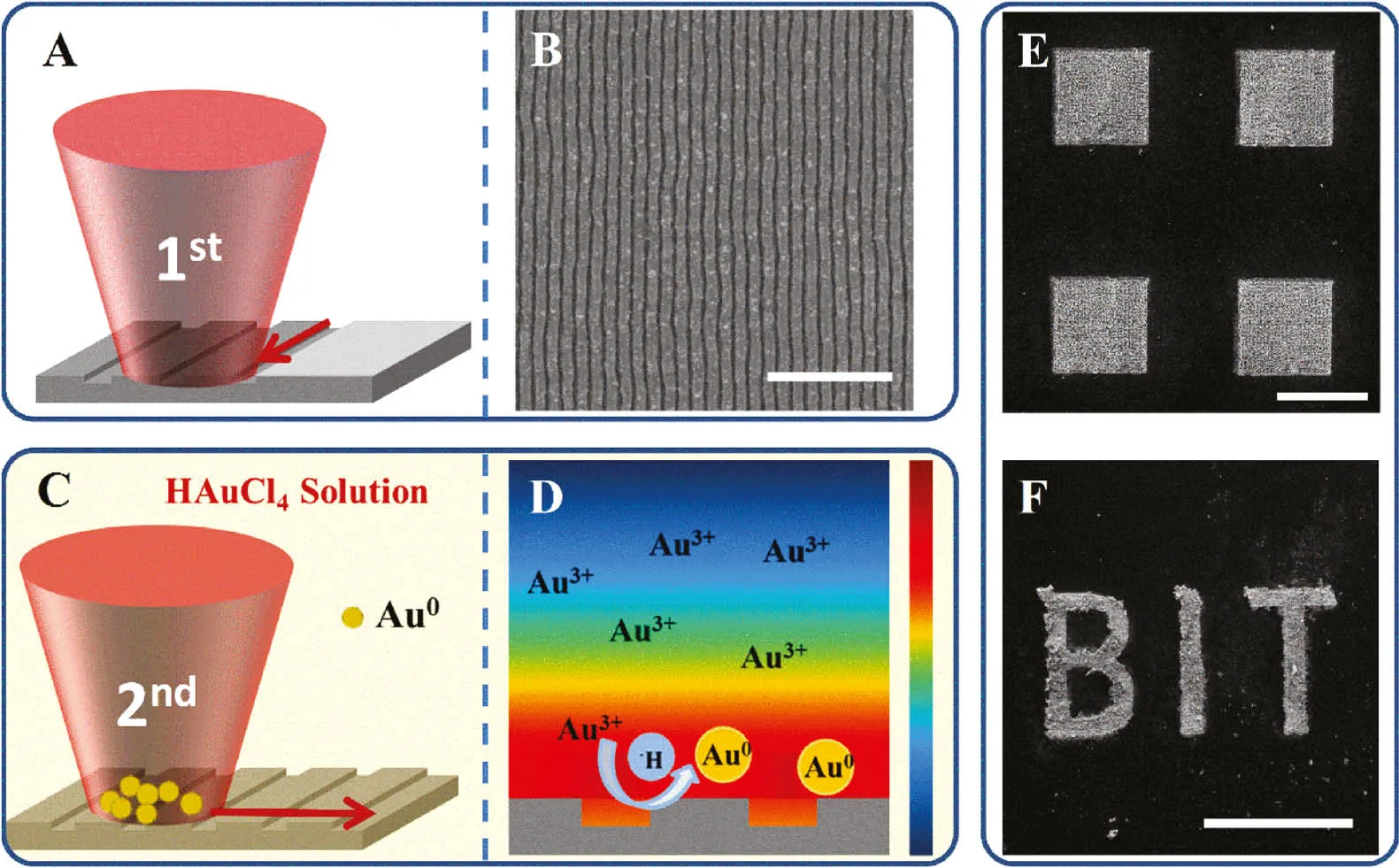
Figure: Femtosecond laser irradiation in air and photoreduction in a gold-containing solution (LOFE); SEM images of periodic surface structures, square arrays, and “BIT”-shaped patterns.
The application of femtosecond lasers in the field of micro/nano technology is especially important. Using photopolymerization triggered by femtosecond lasers, scientists and engineers can fabricate extremely fine structures. This technology has been widely used in the manufacture of microfluidics, biomedical devices, and photonic components. In microfluidics, femtosecond lasers can be used to fabricate complex microfluidic channels and devices; in biomedicine, femtosecond lasers can be used to fabricate implants, tissue-engineering scaffolds, and other miniature medical devices; photonic components such as waveguides and gratings can also be precisely fabricated through femtosecond-laser-initiated photopolymerization.
In addition, femtosecond lasers also play an important role in 3D printing and stereolithography. Using the precisely controlled focal spot of the femtosecond laser, complex structures and shapes can be built layer by layer in three-dimensional space. This technology is significant for rapid prototyping, biological tissue engineering, and the manufacture of complex geometries.
The high precision and high resolution of the femtosecond laser enable photoinitiated photopolymerization to be performed at finer scales. This is crucial for fabricating highly complex and high-precision micro/nano structures. For example, in microelectronics and MEMS manufacturing, femtosecond lasers can be used to fabricate extremely small components and devices.
In summary, the femtosecond laser plays a vital role in the field of photoinitiated photopolymerization. It not only provides a method for precisely controlling the polymerization process but also opens new applications in micro/nano technology, 3D printing, biomedicine, microelectronics, and other fields.