High-Power Yb Femtosecond Lasers and OPA-Pumped Ultrafast Spectroscopy
HELIOS-10W-HE、Femtosecond Laser、Yb Laser、OPA、Pulse Picker、Ultrafast Spectroscopy
June 11, 2026
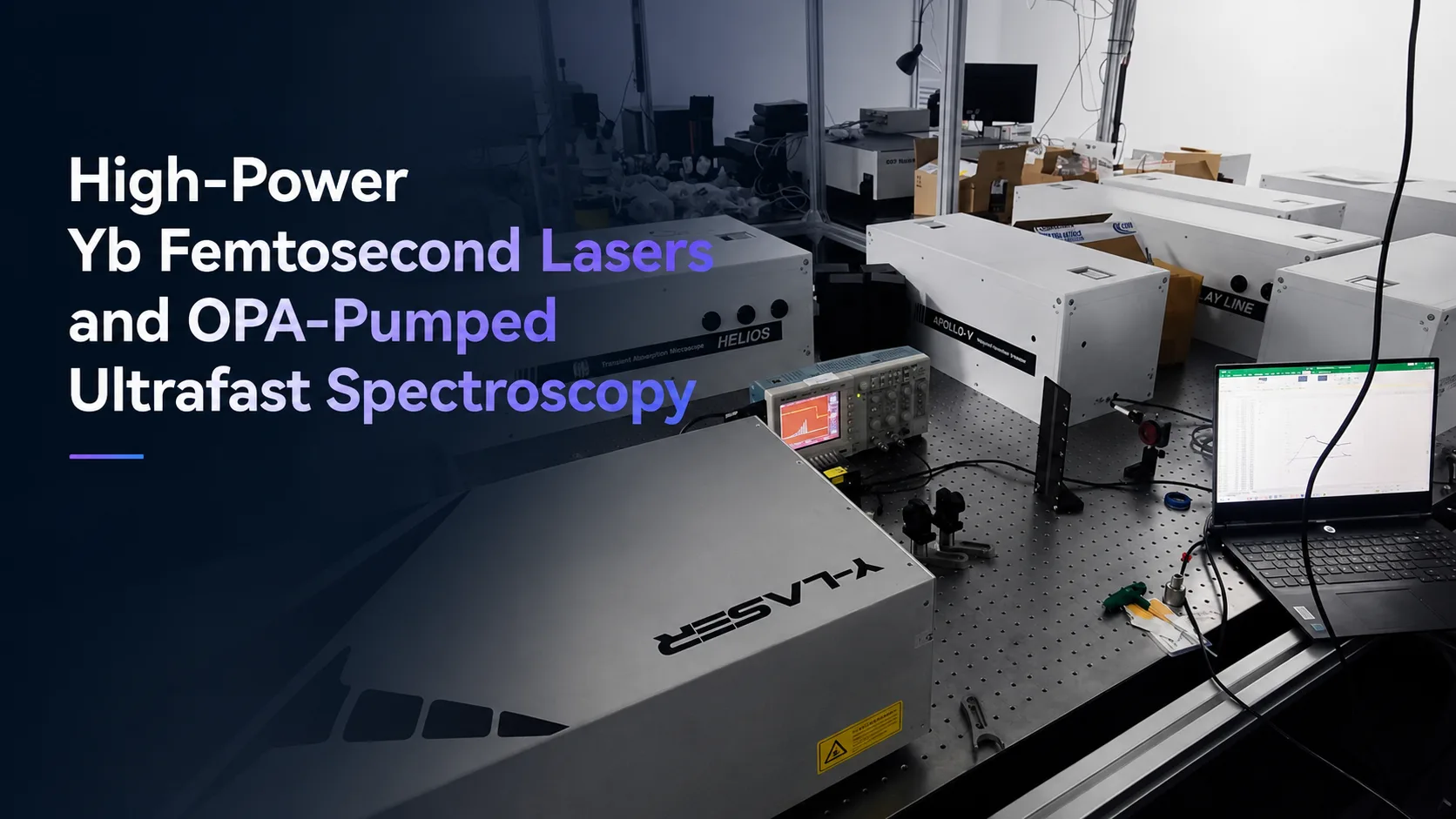
Lead: 1.13 mJ / 228 fs / 0.08 % RMS @ 48 h — one master laser unlocking the complete workflow of OPA pumping, white-light continuum generation, and high-repetition-rate scanning.
Ultrafast spectroscopy is the core experimental paradigm for resolving the coupled electron–phonon–ion dynamics inside condensed matter. Starting from a 1030 nm Yb femtosecond master laser, optical parametric amplification (OPA) extends the wavelength from UV to mid-IR, while a femtosecond white-light continuum (WLC) provides the broadband probe — together forming the physical foundation of transient absorption (TA / pump-probe), 2D-IR, time-resolved photoluminescence (TR-PL) and related techniques. Turning that physics into an engineered platform that actually produces publication-quality data, however, places a multi-dimensional set of demands on the master laser that go far beyond "enough power": pulse energy must clear the OPA gain saturation threshold; pulse duration must sit inside the Yb gain bandwidth; long-term stability must drop below the TA differential signal baseline; beam quality must approach the diffraction limit; and the repetition rate must be selectable across multiple orders of magnitude on demand.
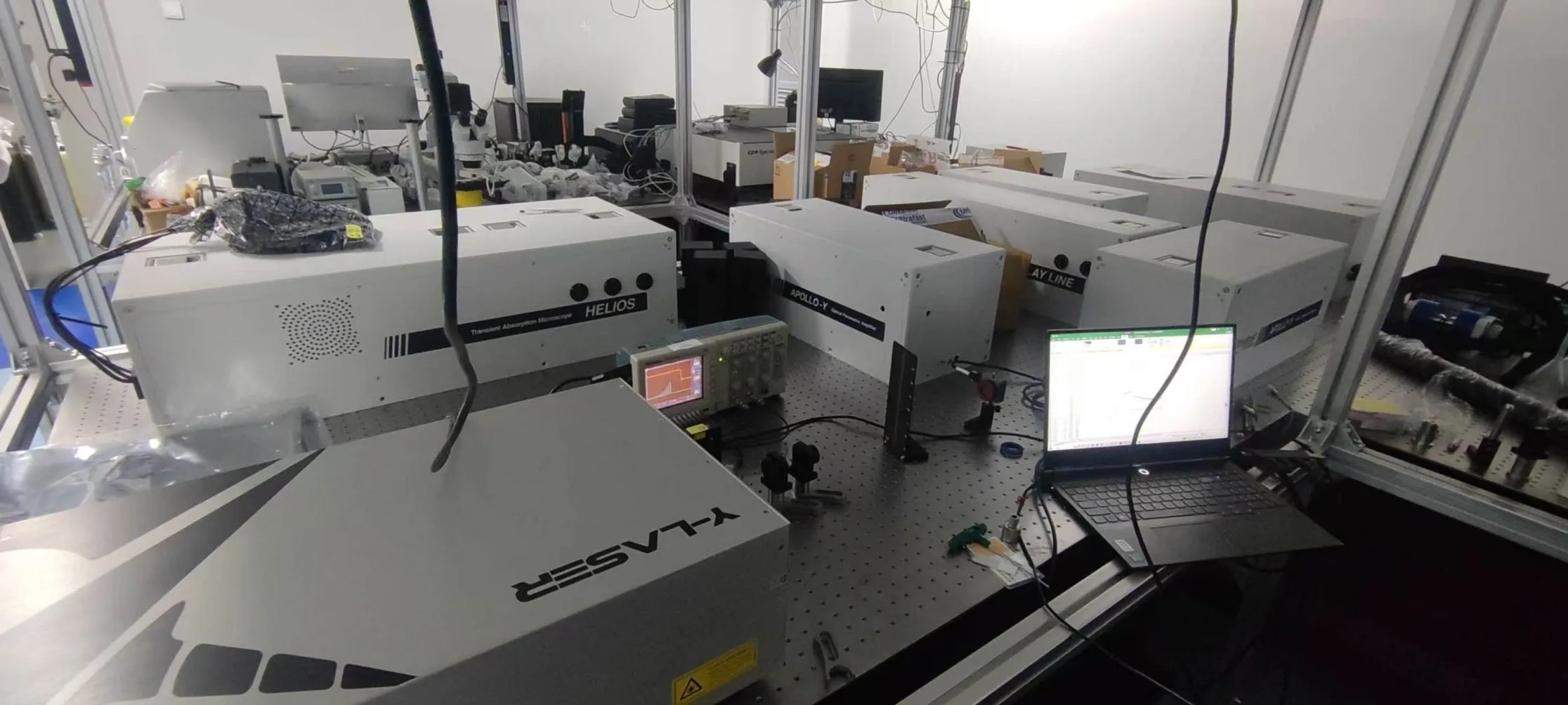
Y-LASER has recently delivered a HELIOS-10W-HE high-power Yb femtosecond master laser (with integrated pulse picker) to an ultrafast spectroscopy group at a leading research university in the photonics/optoelectronic information field, where the master serves as the dedicated pump source for the group's existing Ultrafast Systems OPA. Factory acceptance data: 1.13 mJ / 228 fs / 11.2 W at 10 kHz, 157 µJ / 271 fs / 15.7 W at 100 kHz; 48-hour long-term power stability of 0.08 % RMS; beam quality M²x = 1.089 / M²y = 1.092 at 10 kHz — near the diffraction limit; pulse picker continuously selectable from 1 Hz to 100 kHz. One master, three classes of ultrafast experiments — TA pump-probe, high-repetition-rate spectroscopy, and single-shot triggered measurements — converge on the same platform.
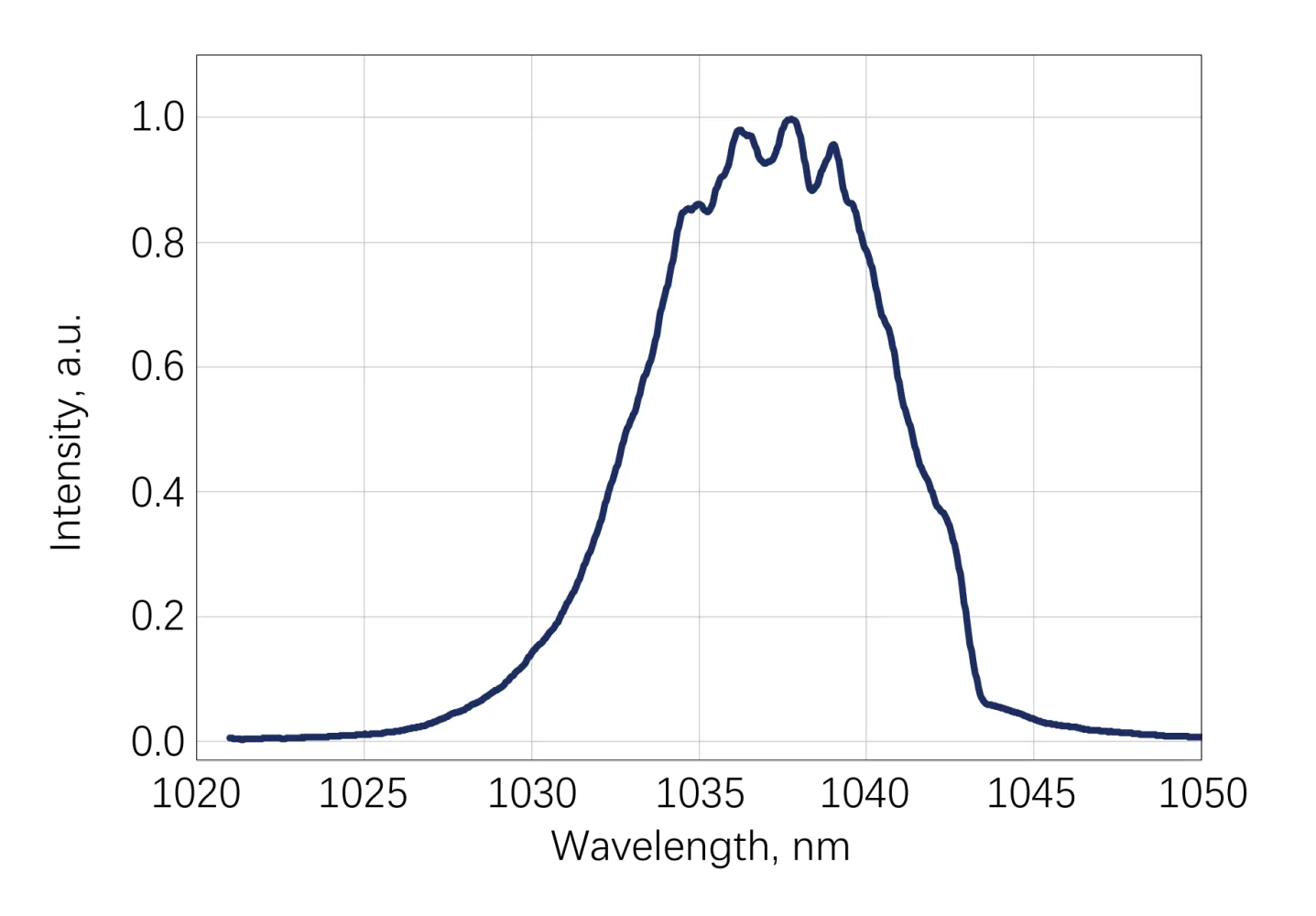 | 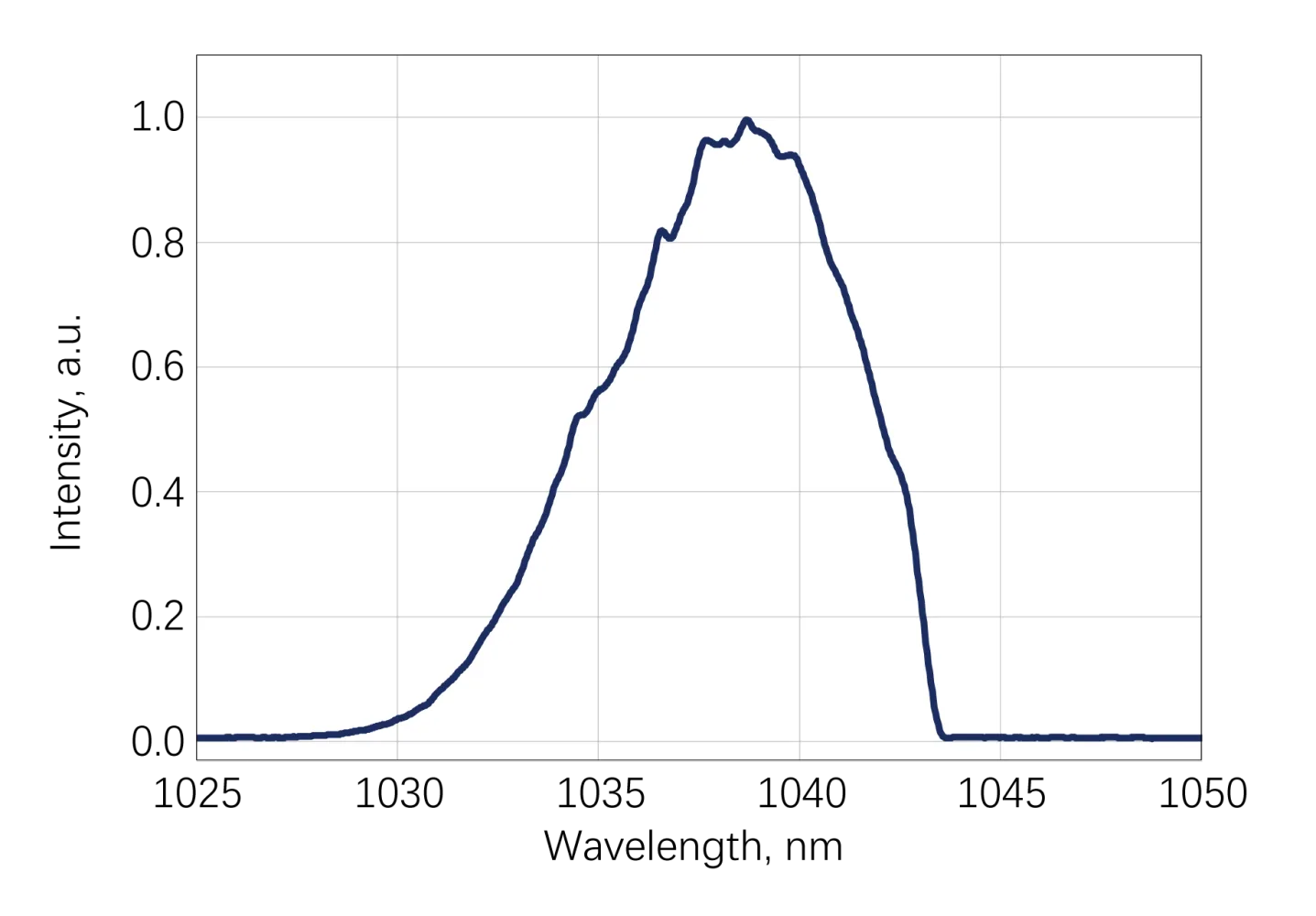 |
Fig. 1&2 HELIOS-10W-HE output spectrum: 10 kHz → 1037 nm center / 8.42 nm bandwidth; 100 kHz → 1038.2 nm center / 7.74 nm bandwidth (YOKOGAWA AQ6370B) | |
1. The physics behind OPA-pumped ultrafast spectroscopy
1.1 OPA: from 1030 nm to broadband tunability
An optical parametric amplifier (OPA) uses a 1030 nm femtosecond seed in a nonlinear crystal (typically BBO) to drive parametric down-conversion, producing two output arms — signal (630 – 1030 nm) and idler (1030 – 2600 nm). Cascading SHG (315 – 630 nm) and DFG (3 – 10 µm) stages then extends coverage from deep UV to deep mid-IR. OPA conversion efficiency depends heavily on three pump-side parameters: pulse energy (sets gain saturation), pulse duration (sets peak intensity), and M² (sets the effective interaction volume). Miss any one of them and the OPA's output "penalty" can easily reach 5–10 % in efficiency per stage.
1.2 Femtosecond white-light continuum: the foundation of broadband probing
A white-light continuum (WLC) is generated when a femtosecond pulse self-focuses in a YAG or Sapphire crystal, where self-phase modulation (SPM) and self-steepening broaden the spectrum from ~350 nm out beyond 1600 nm. WLC is the standard probe source for TA, and its shot-to-shot stability sets the noise floor for the TA differential signal. WLC stability, in turn, is locked to three properties of the driving laser: long-term power stability, spatial mode quality, and precise pulse-energy control — meaning sub-0.1 % long-term stability and M² < 1.1 at the master are physical preconditions for publication-grade WLC.
2. Hard specs that OPA-pumped ultrafast spectroscopy demands of the driver
The right-hand column shows HELIOS-10W-HE factory acceptance data — all six hard specs are met, with most exceeded by a comfortable margin.
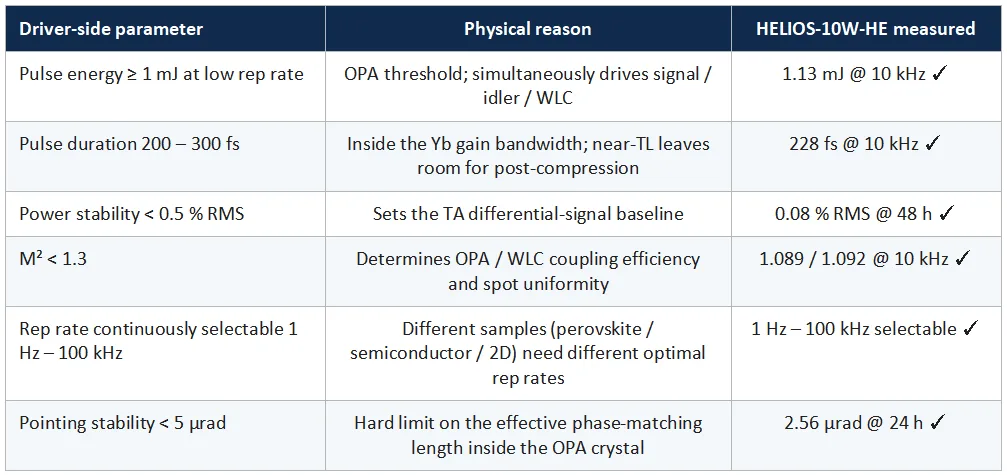
3. HELIOS-10W-HE factory acceptance data
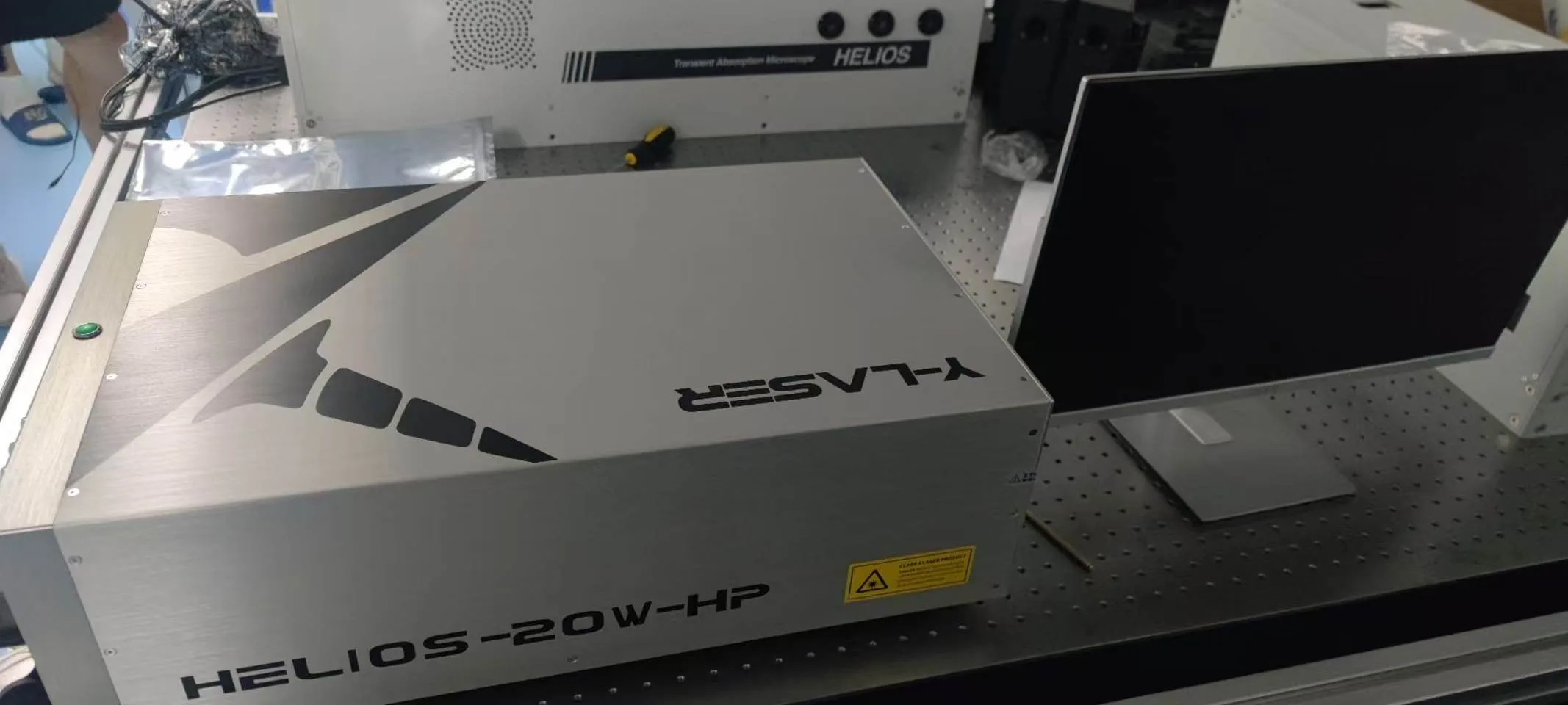
HELIOS-10W-HE is built on an all-solid-state Yb CPA architecture (regenerative amplifier + multi-pass amplifier + integrated pulse picker), pumped directly by diodes with a quantum defect of roughly 8 %. The factory acceptance report (serial YLM250303001) characterizes both 10 kHz and 100 kHz operating points.
3.1 10 kHz operating point: the OPA-pumping workhorse
■ Center wavelength 1037 nm; −3 dB spectral bandwidth 8.42 nm (YOKOGAWA AQ6370B)
■ Pulse duration 228 fs (Gaussian fit, R² = 1.000, PulseCheck NX S09706)
■ Single-pulse energy 1.13 mJ at 11.2 W average power
■ Transform-limited duration TL ≈ 188 fs; measured 228 fs is 1.21 × TL — leaving headroom for an external MPC post-compressor to reach sub-50 fs
3.2 100 kHz operating point: the high-rep-rate workhorse
■ Center wavelength 1038.2 nm; −3 dB spectral bandwidth 7.74 nm
■ Pulse duration 271 fs (Gaussian fit, R² = 0.999)
■ Single-pulse energy 157 µJ at 15.7 W average power
■ Average power at 100 kHz is actually higher than at 10 kHz — a typical thermal-equilibrium effect: at high rep rate the amplifier chain settles into a steadier extraction regime, slightly improving overall conversion
3.3 Long-term stability metrics
■ Power stability: RMS = 0.08 % (48-hour continuous burn-in, 11.2 W average, 60F-DC-25U thermal head)
■ Pointing stability: 2.56 µrad (24-hour continuous monitoring, centroid RMS = 1.28 µm at 500 mm focal length, WinCamD-LCM)
■ Beam quality M² @ 10 kHz: M²x = 1.089 / M²y = 1.092 (BSQ-SP920 / Ophir BeamSquared)
■ Beam quality M² @ 100 kHz: M²x = 1.077 / M²y = 1.100
228 fs sits exactly in the OPA-pumping sweet spot: short enough to deliver high peak intensity and gain in the BBO crystal, long enough to stay safely below the nonlinear damage threshold. 0.08 % RMS over 48 hours means that when a TA experiment averages thousands of scans, the pump's contribution to the differential signal stays well below the sample's intrinsic dynamics. And M² ≈ 1.09 translates directly into higher OPA and WLC coupling efficiency. Together, these three numbers separate "publication-quality TA data" from "signal that survives only after heroic averaging."
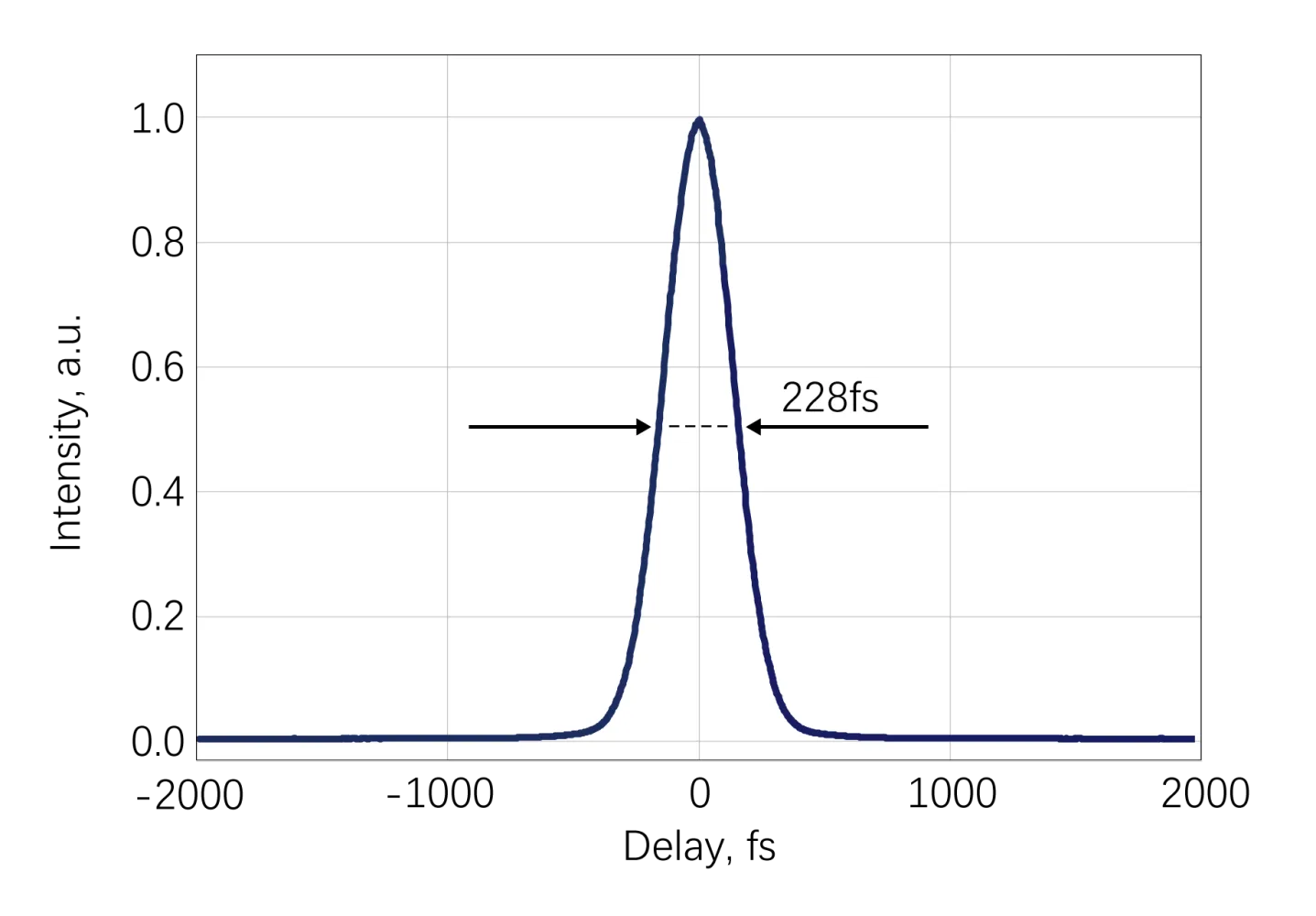 | 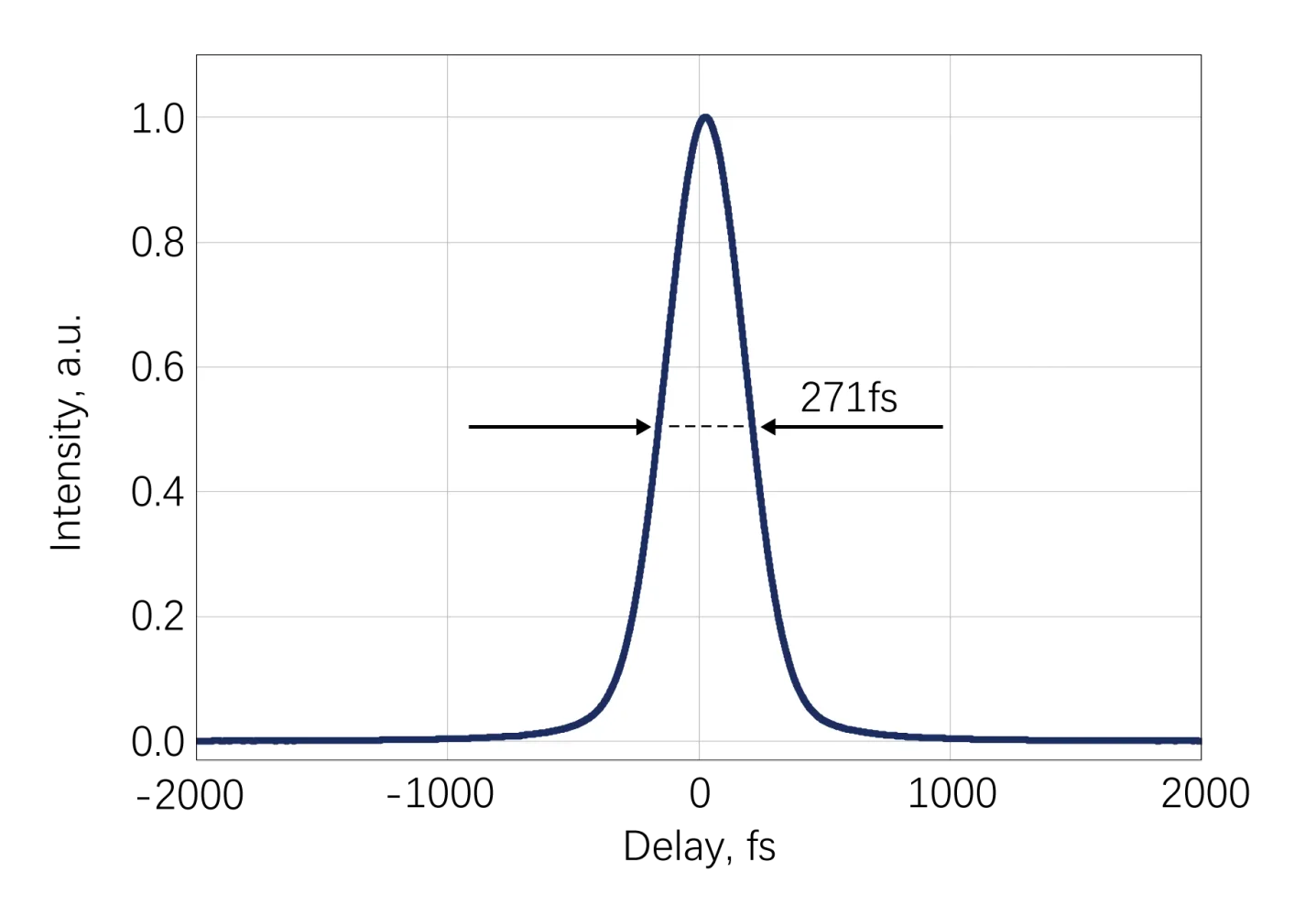 |
Fig. 3&4 HELIOS-10W-HE autocorrelation: 10 kHz → 228 fs / 100 kHz → 271 fs, Gaussian fit (PulseCheck NX S09706) | |
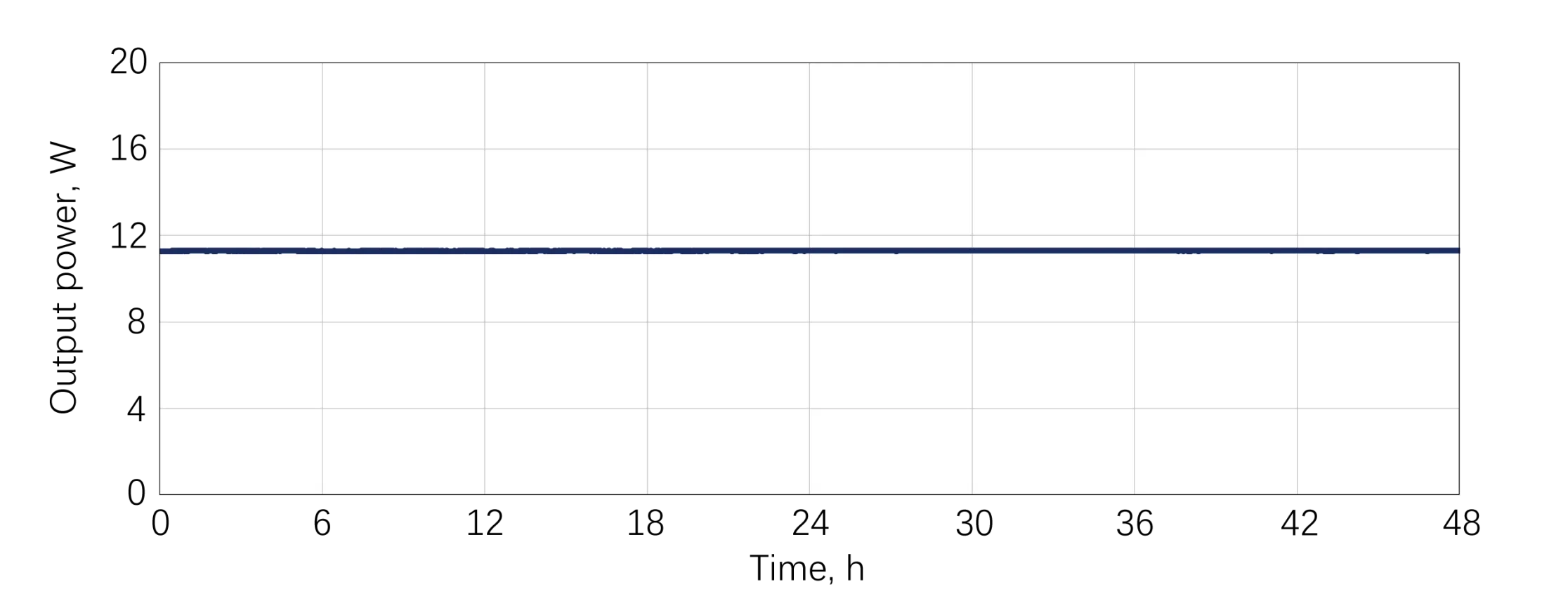 | 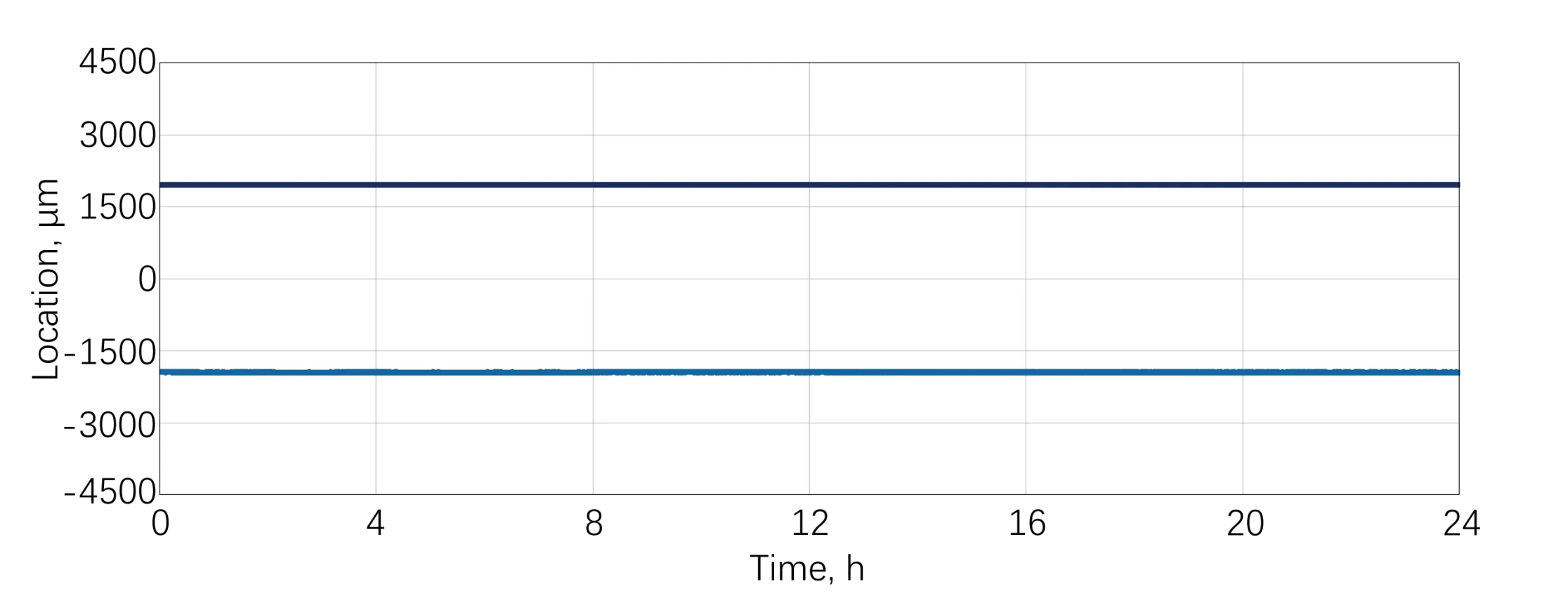 |
Fig. 5 HELIOS-10W-HE 48-hour long-term power stability: 11.2 W average · RMS = 0.08 % (60F-DC-25U S/N:224103120 · reconstructed from acceptance-report RMS = 0.08 %) | Fig. 6 HELIOS-10W-HE 24-hour pointing stability: F = 500 mm focusing · centroid RMS = 1.28 µm · 2.56 µrad (WinCamD-LCM · reconstructed from acceptance-report RMS = 1.28 µm) |
4. Pulse picker: engineering the repetition-rate freedom axis
A typical industrial Yb femtosecond laser has a seed running at ~10 MHz intracavity, and its amplifier output rep rate is fixed by the regenerative cavity triggering electronics — typically pinned at one of 10 kHz, 50 kHz, or 100 kHz. Research experiments, however, demand rep rates that span orders of magnitude and depend on the sample:
■ Perovskite thin films: free-carrier lifetimes of 100 ns – 1 µs require rep rates ≤ 100 kHz; otherwise the excited state from the previous pulse has not yet relaxed when the next pulse arrives, and "heat accumulation" buries the real dynamics;
■ CdSe / CsPbBr₃ quantum dots: Auger recombination times in the nanosecond regime, where a 1 MHz drive can simply thermally damage the sample;
■ Coherent phonon dynamics in ZnO / TMDs: experiments need ~1 kHz triggering to leave several milliseconds for "cool-down and reset" between shots;
■ Photoluminescence (PL) fast spectroscopy: higher rep rate (e.g. 100 kHz) is preferred to maximize photon count per unit time and shorten exposure.
Without a pulse picker, a single master laser is locked to one factory-set rep rate; every new sample type would require swapping out the master. A pulse picker turns the amplifier's output pulse train into a programmable sequence: by extracting one pulse out of every N from a 100 kHz train, the rep rate is precisely reduced to 1 kHz, 100 Hz, 10 Hz, or down to a single-shot trigger at 1 Hz.
HELIOS-10W-HE integrates the pulse-picker module natively inside the master (no external EOM needed) and exposes it through a single unified control interface. The factory acceptance report characterizes both 10 kHz and 100 kHz operating points completely — center wavelength, pulse duration, and M² are essentially identical at the two rep rates, confirming that the pulse picker introduces neither spatial-mode distortion nor measurable phase artifacts. In practice, this means users get "acceptance-report-grade performance at any rep rate they choose," with no fear of degradation after switching.
5. One master, three classes of ultrafast experiments
The HELIOS-10W-HE + Ultrafast Systems OPA combination covers three distinct experimental modes on the same platform in this group's laboratory:
Mode A: OPA-pumped TA pump-probe (@ 10 kHz)
HELIOS at 10 kHz delivers 1.13 mJ / 228 fs into the Ultrafast Systems OPA, generating a continuously tunable signal/idler across roughly 230 – 2600 nm as the pump beam; a separate ~5 µJ branch drives a 5 mm YAG crystal to produce the white-light continuum probe. The 10 kHz rep rate matches the ~100 µs carrier lifetimes of typical perovskite and semiconductor samples; a mechanical chopper at 1:2 ratio gives a 5 kHz modulation frequency that sits comfortably inside the lock-in detection bandwidth used for the differential measurement.
Mode B: high-repetition-rate fast scanning (@ 100 kHz)
HELIOS at 100 kHz delivers 157 µJ / 271 fs at 15.7 W average power for fast TA scans or PL fast spectroscopy. The same OPA chain operates at lower pulse energy and higher rep rate, with SNR ∝ √N accumulating faster per unit time. M² at 100 kHz holds at 1.077 / 1.100, so the OPA front end sees essentially the same beam quality as at 10 kHz. This mode is particularly suited to throughput-intensive experiments — material screening, exciton-exciton interaction sweeps, multi-wavelength scans across large parameter spaces.
Mode C: single-shot triggering and timing-gated experiments (@ 1 Hz – 1 kHz)
By reducing the rep rate to 1 Hz – 1 kHz through the pulse picker, HELIOS can drive single-shot experiments: low-repetition-rate pumping of coherent phonon dynamics, threshold calibration of high-peak-power nonlinear effects, or coordinated triggering with a mechanical delay line for picosecond-to-nanosecond temporal scans. Single-shot triggering at 1 Hz is also routinely used for detector calibration and electronic-chain synchronization.
Three experimental modes — one master, one OPA, one white-light branch. This is what a Yb femtosecond platform looks like once it has graduated from "a laser" to "a benchtop infrastructure".
6. Closing thought
1.13 mJ, 228 fs, 0.08 % RMS @ 48 h, M² ≈ 1.09, and 1 Hz – 100 kHz pulse-picker range — these five numbers from HELIOS-10W-HE correspond to the five physical dimensions OPA-pumped ultrafast spectroscopy actually demands: an energy threshold, a pulse-duration sweet spot, long-term stability, beam-mode quality, and repetition-rate flexibility. Any one of them missing and the downstream OPA / WLC / TA chain loses signal-to-noise and experimental throughput by a meaningful factor.
By engineering all five dimensions into a single standardized master, Y-LASER lets ultrafast spectroscopy groups stop making the painful "energy vs. rep rate vs. stability" trade-off — and instead run perovskite, semiconductor, 2D-material, and quantum-dot experiments through the same platform from start to finish. This is the quantitative evidence that high-power Yb femtosecond masters have crossed the threshold from "usable" into "benchtop-standard" — a foundation the rest of the ultrafast-spectroscopy field can now build on.