Femtosecond Lasers and Few-Cycle Pulse Science
HELIOS-20W-HE、HYPERION-G-HE、Femtosecond Laser、Yb Laser、MPC、Pulse Compression、HHG、EUV、XUV、Attosecond
June 18, 2026
Lead: 201.4 fs → 40.4 fs / 5× compression / 95.97 % transmission / 46.8 GW peak power — one Yb master plus one multi-pass cell brings industrial femtosecond lasers into the few-cycle era.
Over the past decade, industrial 1030 nm Yb femtosecond lasers — low thermal load, long lifetime, diode-pumped — became the de-facto standard for high-power femtosecond platforms, routinely delivering mJ-class single-pulse energy and sub-0.1 % long-term power stability. But the Yb gain medium has a hard physical ceiling on pulse duration: a gain bandwidth of only 5–10 THz means direct Yb output rarely drops below 200 fs. Meanwhile the next ultrafast frontier — strong-field ionization, attosecond pulse generation, high-harmonic generation (HHG), solid-state HHG (sHHG), attosecond streaking, ultrafast electron diffraction — almost all demand sub-50 fs pulse durations together with GW-class peak power. The gap between direct Yb output and the few-cycle regime has to be bridged by an external post-compression stage.
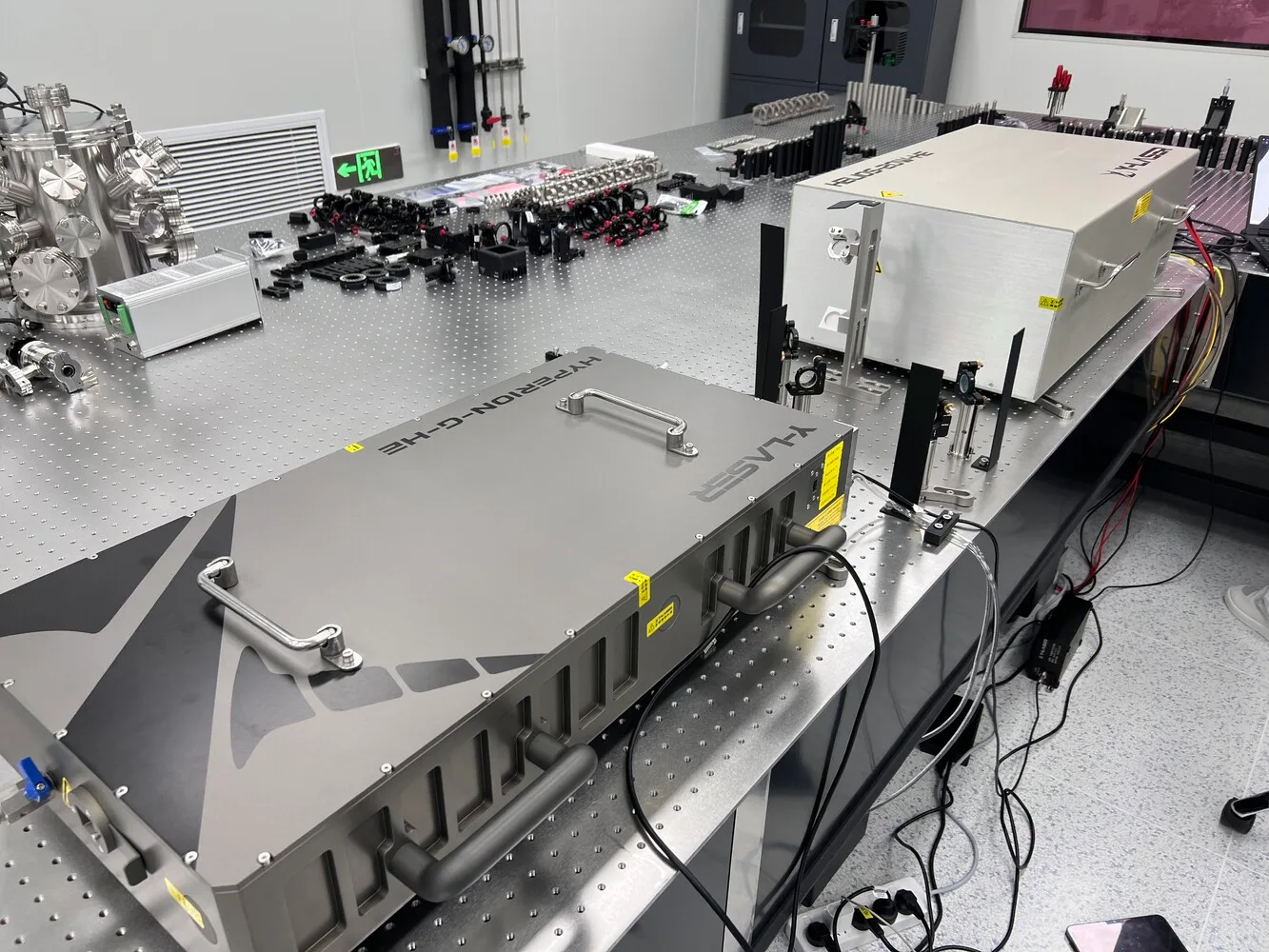
Y-LASER has recently delivered a HELIOS-20W-HE high-energy femtosecond master laser combined with a HYPERION-G-HE multi-pass cell (MPC) nonlinear pulse compressor to an ultrafast laser physics group at a leading optics research institute. HELIOS-20W-HE delivers 2.15 mJ / 226.6 fs / 21.5 W at 10 kHz, with 0.035 % RMS power stability over 24 hours, M² ≈ 1.12, and 1000 : 1 pre-pulse contrast. After the HYPERION-G-HE stage, output pulse duration compresses to 40.4 fs while retaining 1.89 mJ of single-pulse energy at 95.97 % overall transmission, with a beam ellipticity of 99 %. This is the first time an industrial Yb femtosecond platform has delivered sub-50 fs pulse duration while preserving the full mJ-class energy budget.
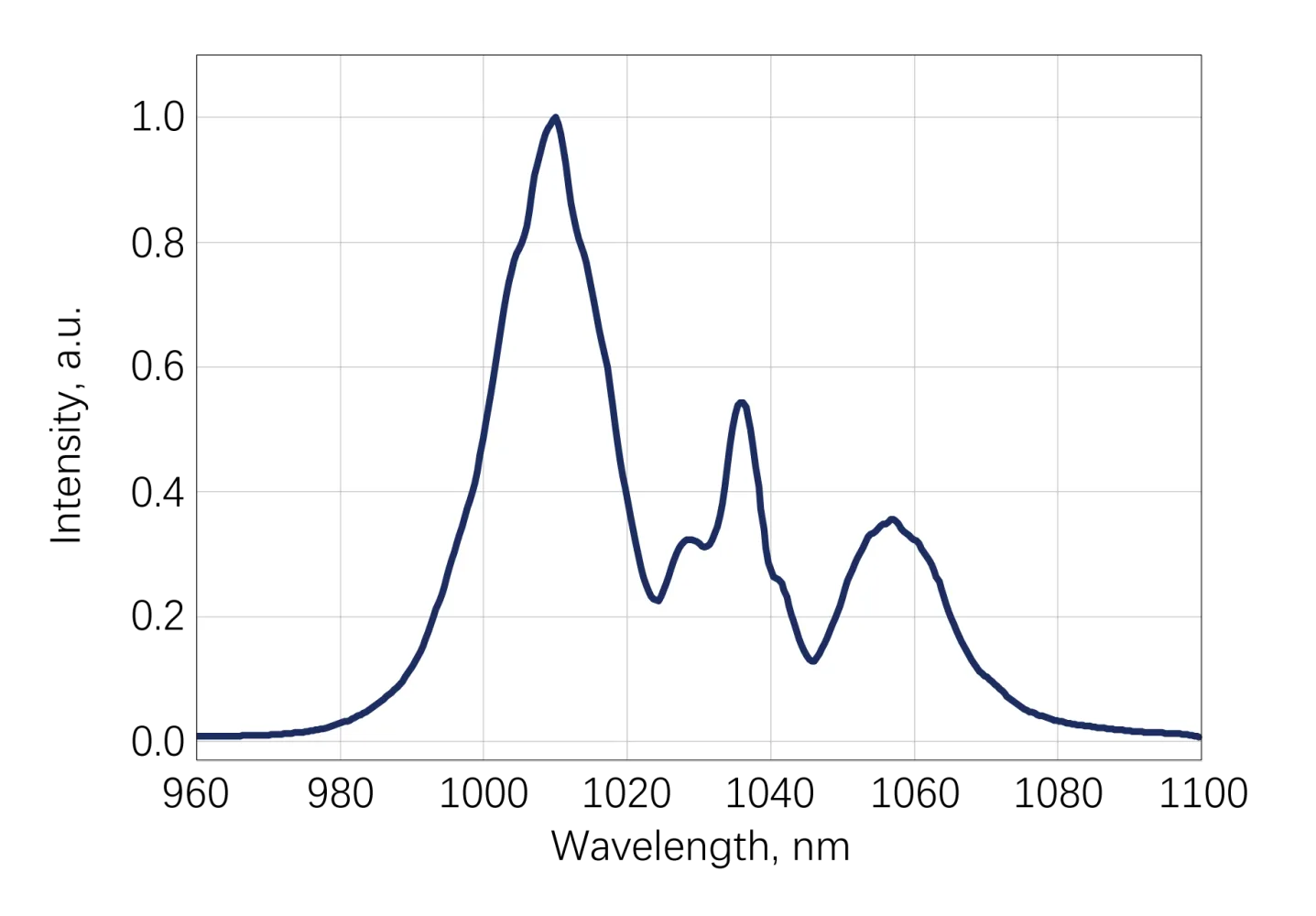 | |
HYPERION-G-HE output spectrum — SPM broadens the input from ~10 nm to a −10 dB bandwidth of 79 nm across 960–1100 nm (Chuangshi L/300-1100 spectrometer) |
1. Few-cycle femtosecond pulses: physics and the application pull
1.1 The Yb gain-bandwidth ceiling
Throughout the femtosecond era, Yb-doped media (Yb:KGW, Yb:YAG, Yb:CALGO) displaced earlier Ti:Sapphire platforms thanks to higher quantum efficiency, lower thermal load, and reliable diode-direct pumping. But the trade-off is gain bandwidth: Ti:Sapphire offers roughly 200 THz of gain bandwidth (transform-limited duration < 10 fs); a typical Yb medium offers only 5–10 THz, corresponding to a TL duration of about 150–250 fs. In other words, direct Yb output is physically pinned near 200 fs by the gain material itself.
Meanwhile the frontier of ultrafast science has migrated decisively toward shorter durations: strong-field ionization, attosecond pulse drive, HHG cut-off scaling, and the temporal resolution of ultrafast electron diffraction (UED) all benefit from — or strictly require — sub-50 fs drive. Yb's industrial-grade stability, high average power, and long service life are essentially irreplaceable; what's missing is the engineering step that pushes the output past the 200 fs wall.
1.2 Multi-Pass Cell (MPC) compression: bridging the 200 fs wall
The gas-filled multi-pass cell has emerged in the last five years as the consensus engineering solution for post-compression of industrial Yb lasers. The physics can be captured in three sentences:
■ (1) The femtosecond pulse enters a Herriott-type reflective cavity filled with a few bar of noble gas (typically Ar / Kr / He);
■ (2) The pulse makes 30–60 passes; each pass accumulates self-phase modulation (SPM, n₂I), symmetrically broadening the spectrum and adding a frequency chirp in time;
■ (3) Outside the cavity, chirped mirrors apply the opposite group-delay dispersion (GDD), recompressing the broadened pulse back toward the transform limit.
From an engineering standpoint, MPC offers four advantages simultaneously:
■ Power ceiling. A reflective cavity with a large mode area avoids the bulk-damage thresholds that cap fiber-based broadening, comfortably handling mJ-class single-pulse energies;
■ Spatial-mode preservation. Herriott multi-pass designs keep a Gaussian transverse mode — output M² stays close to input M²;
■ Timing and noise transparency. Mirrors and gas introduce essentially no phase noise; the master's low noise propagates through to the output;
■ Broad spectral broadening. Typical 5–10× broadening compresses 200 fs Yb input down to 30–50 fs — squarely inside the few-cycle experimental regime.
2. Hard specs that few-cycle Yb sources demand of the driver chain
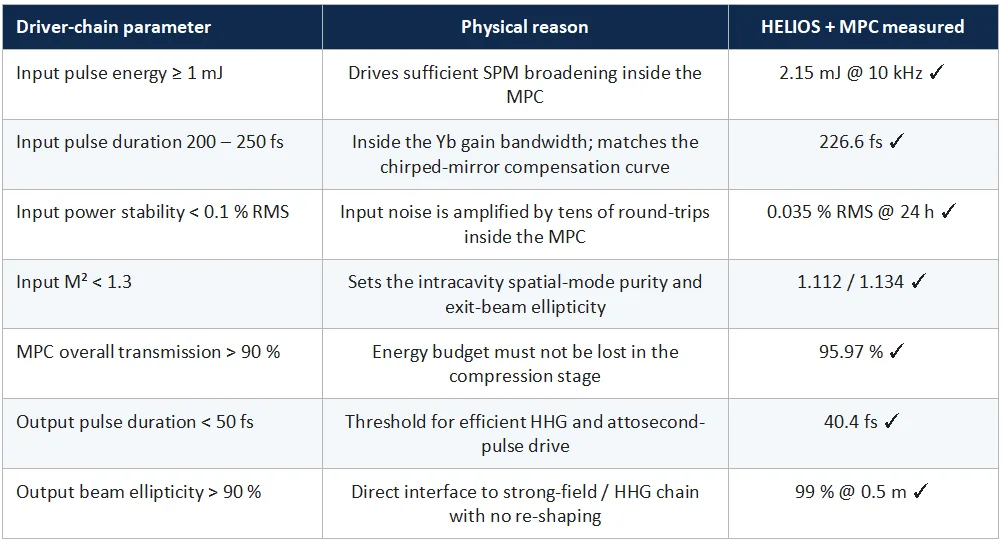
A few-cycle femtosecond source is not the achievement of any single module; it is the result of master × MPC chain co-design. Miss any one of the seven specs below, and the chain fails to deliver sub-50 fs / mJ output. The right-hand column shows measured values for this HELIOS-20W-HE + HYPERION-G-HE delivery — all seven specs met, most with margin.
3. HELIOS-20W-HE: an mJ-class Yb femtosecond master laser
HELIOS-20W-HE is built on an all-solid-state Yb CPA architecture (regenerative amplifier + multi-pass amplifier), pumped directly by diodes, with a quantum defect of roughly 8 %. The factory acceptance report (serial YLM240401002) covers three repetition-rate operating points: 10 / 50 / 100 kHz.
3.1 Three repetition-rate operating points
■ 10 kHz: 226.6 fs / 2.15 mJ / 21.5 W, center wavelength 1039.3 nm
■ 50 kHz: 258.6 fs / 438 µJ / 21.9 W, center wavelength 1039.0 nm
■ 100 kHz: 262.8 fs / 218 µJ / 21.8 W, center wavelength 1039.0 nm
■ Average power is naturally conserved across rep rates (21.5–21.9 W) — the amplifier chain reaches a steady thermal equilibrium at every operating point
3.2 Key stability and beam-quality metrics
■ Power stability: RMS = 0.035 % over 24 hours of continuous burn-in (21.52 W average, 60F-DC-25U thermal head)
■ Pointing stability: 10.2 µrad over 24 hours (centroid RMS = 5.1 µm at F = 500 mm focal length, LT-500-VIS-NIR-HQ profiler)
■ Beam quality M² @ 10 kHz: M²x = 1.112 / M²y = 1.134 — near the diffraction limit
■ Beam quality M² @ 100 kHz: M²x = 1.117 / M²y = 1.120
■ Pre-pulse contrast: 1000 : 1 — sets the upper bound on intracavity energy utilization and beam-quality preservation
0.035 % RMS over 24 hours puts HELIOS-20W-HE in the top tier of mJ-class Yb femtosecond platforms — meaning that even after the MPC amplifies the input noise across many round-trips, the output remains stable. M² ≈ 1.12 near the diffraction limit ensures intracavity spatial-mode purity inside the MPC, which is the physical prerequisite for the 99 % beam ellipticity measured at the MPC exit.
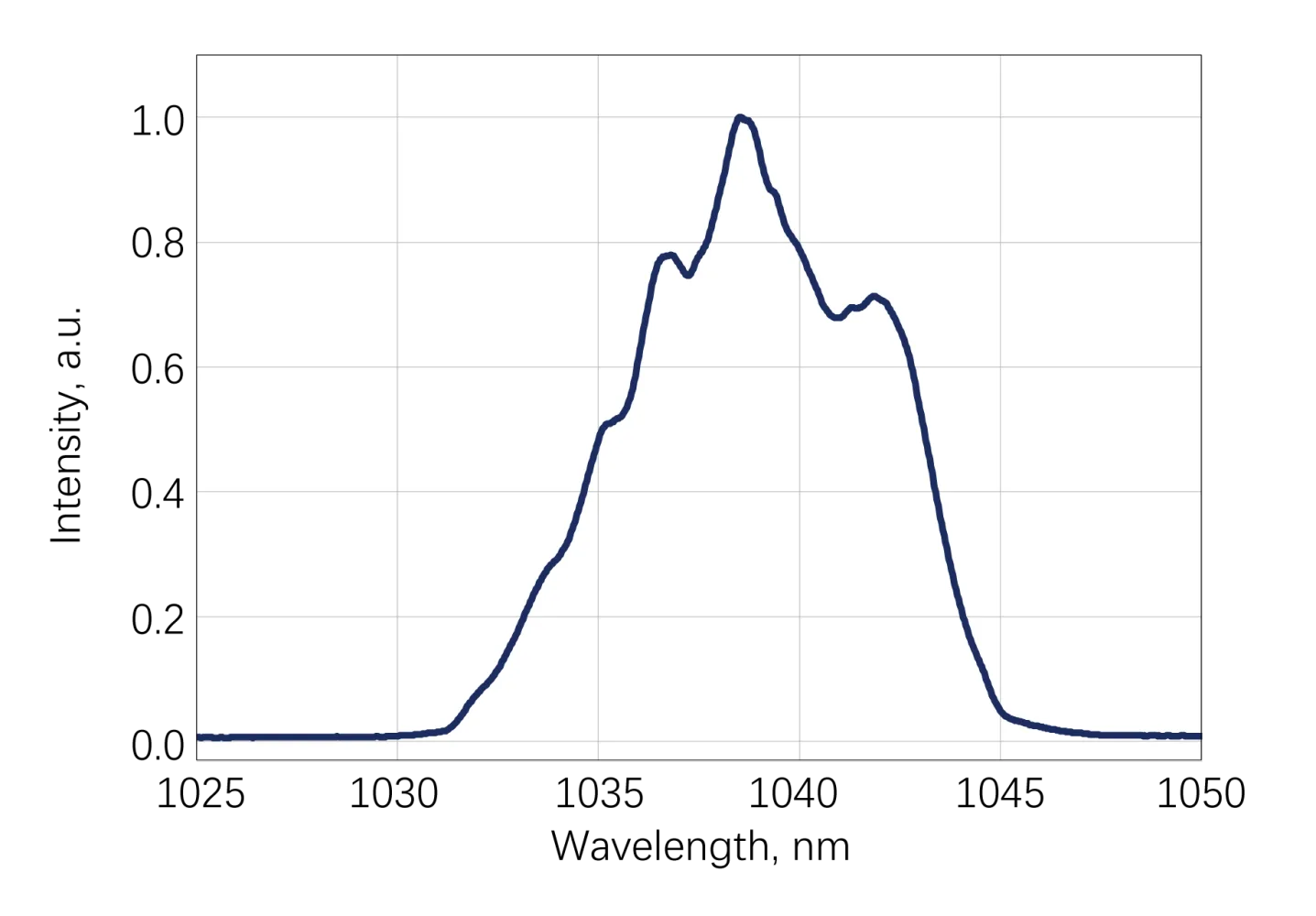 | 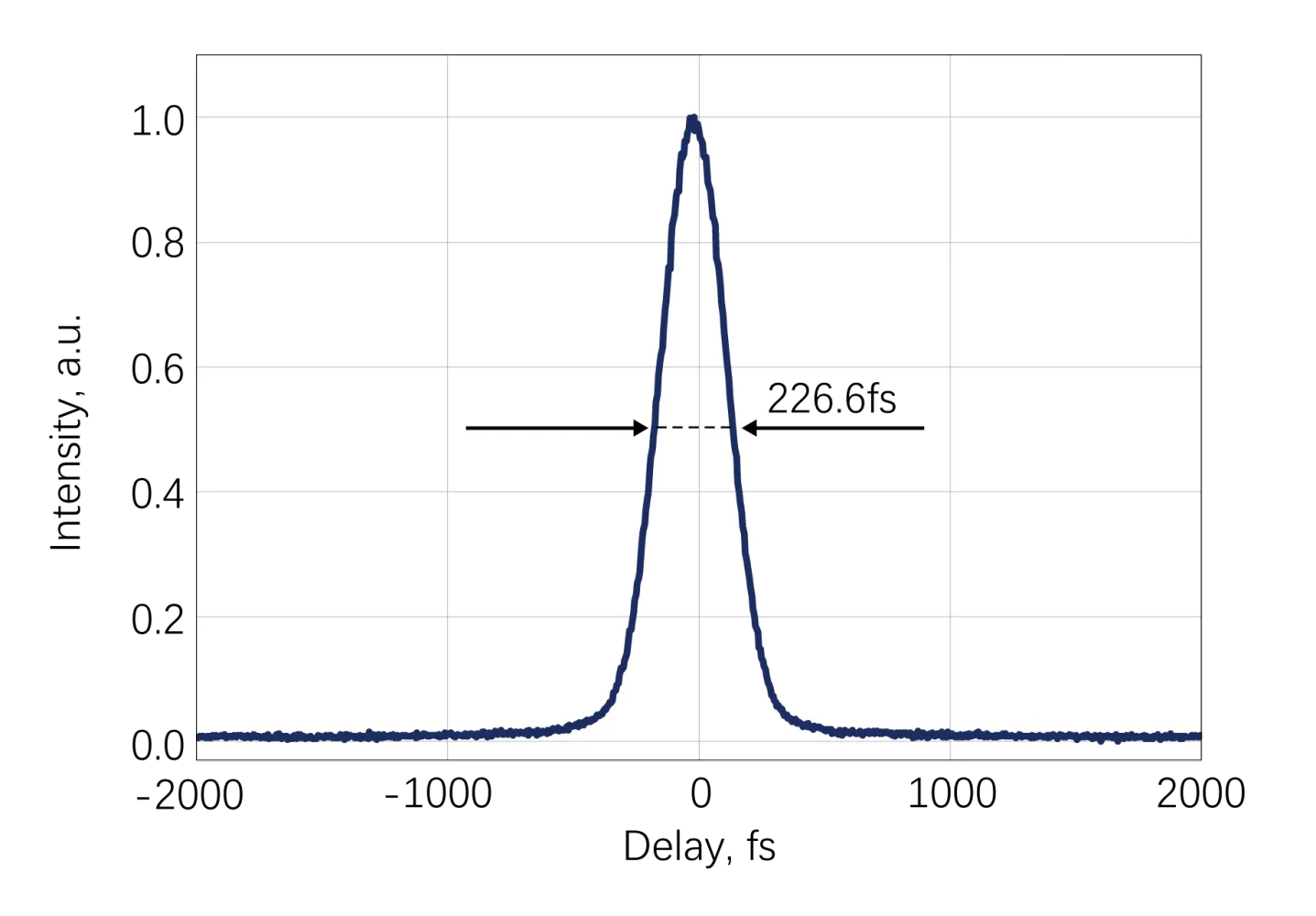 |
HELIOS-20W-HE 10 kHz output spectrum — center wavelength 1039.3 nm (YOKOGAWA AQ6370B) | HELIOS-20W-HE 10 kHz autocorrelation — 226.6 fs FWHM (PulseCheck NX S09706) |
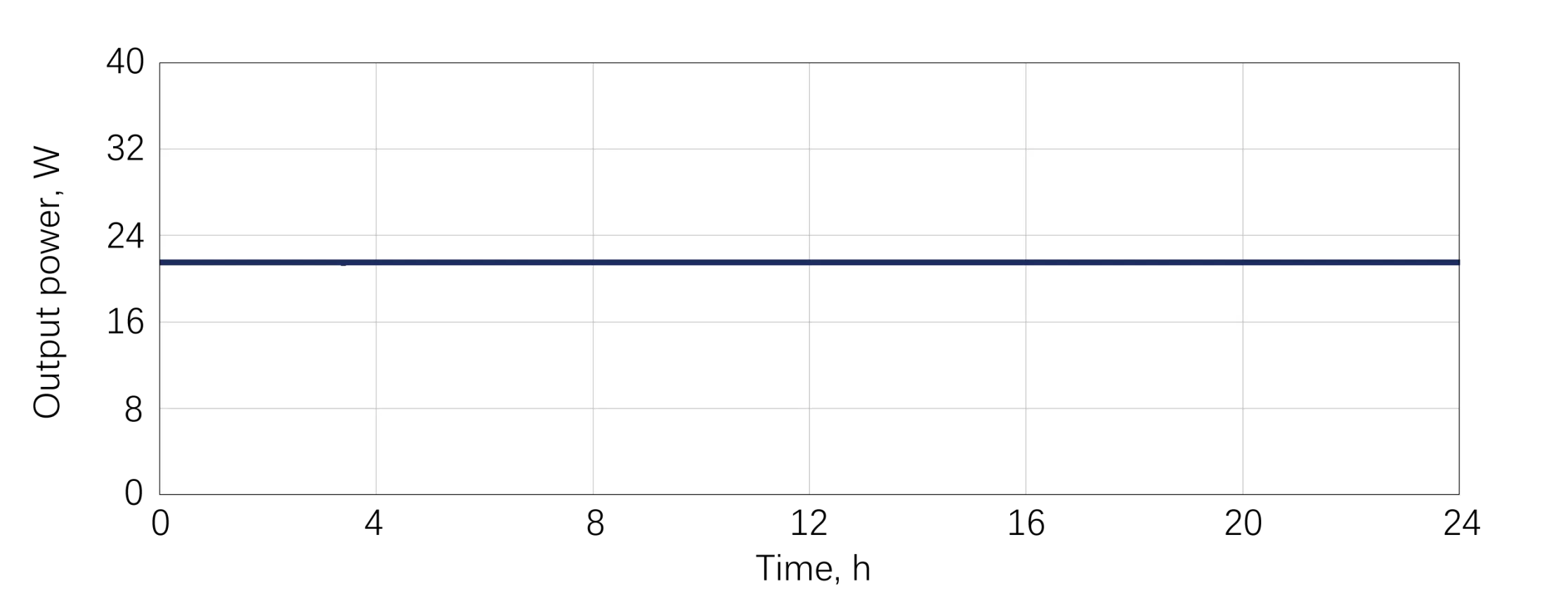 | 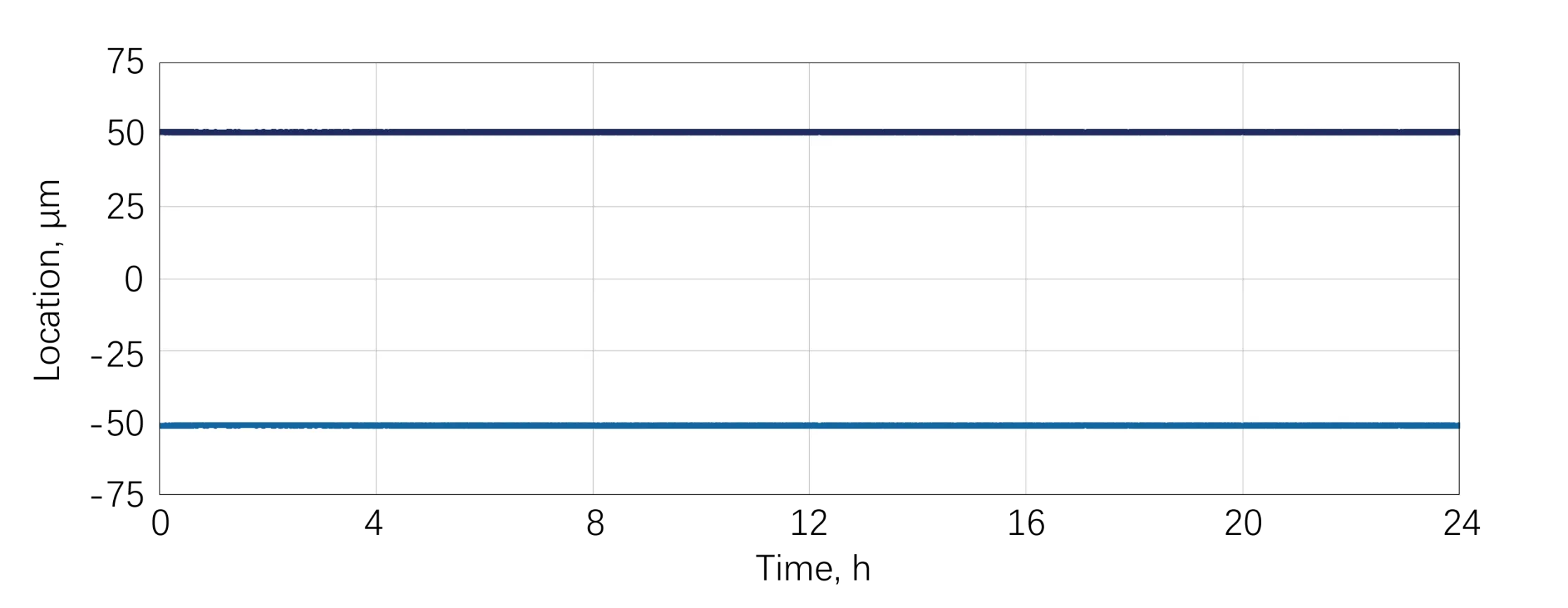 |
HELIOS-20W-HE 24-hour long-term power stability — 21.52 W mean · RMS = 0.035 % (60F-DC-25U thermal head) | HELIOS-20W-HE 24-hour pointing stability — F = 500 mm focusing · centroid RMS = 5.1 µm · 10.2 µrad (LT-500-VIS-NIR-HQ profiler) |
4. HYPERION-G-HE: 5× compression at 95.97 % transmission
HYPERION-G-HE uses a Herriott-type reflective multi-pass cell filled with noble gas as the nonlinear medium, paired with a custom chirped-mirror set for GDD compensation and sub-50 fs output. The factory acceptance report (serial YLM250904001) characterizes the complete input → output chain at 10 kHz.
4.1 Pulse duration: 201.4 fs → 40.4 fs (5× compression)
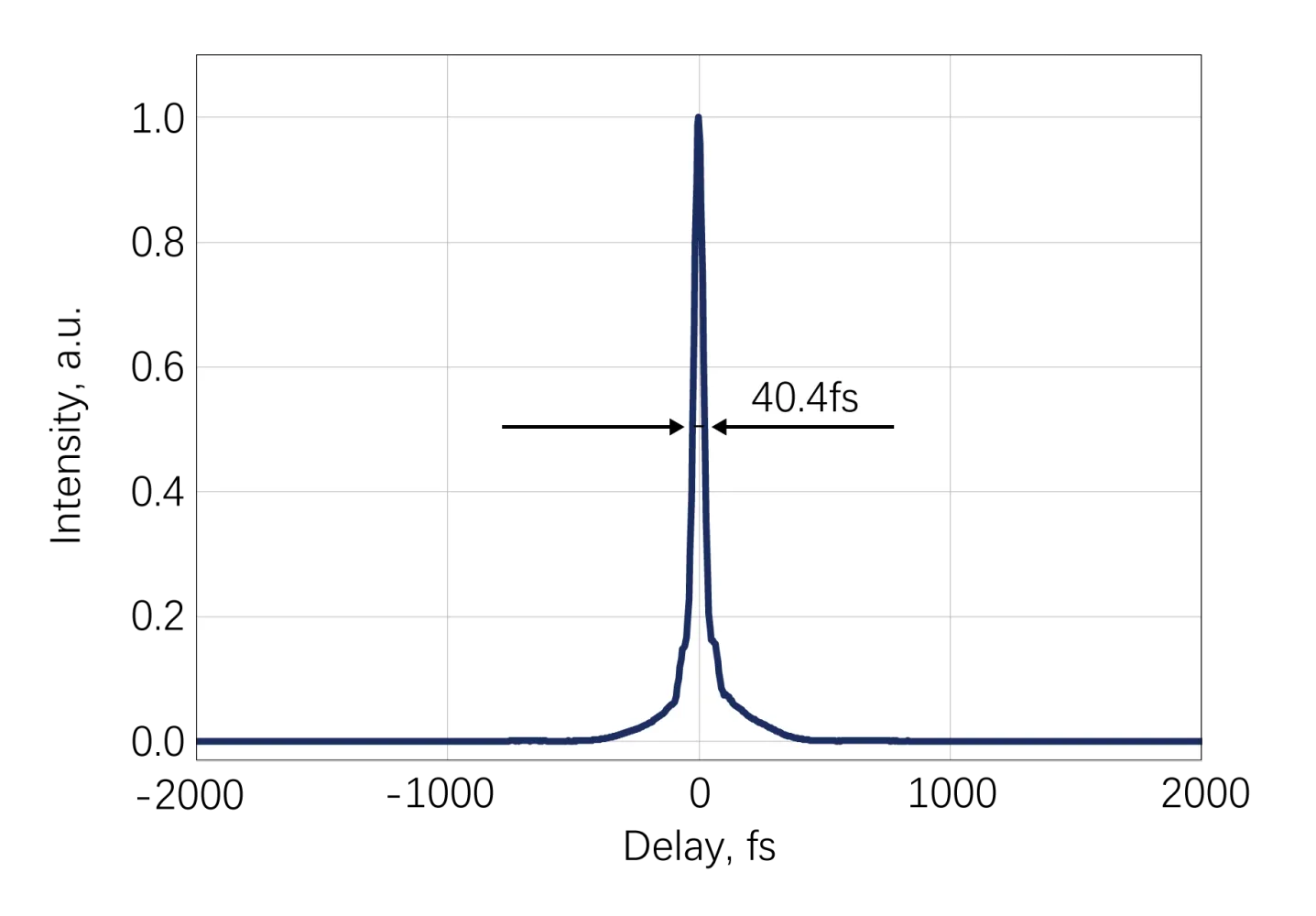
Input: 1.976 mJ / 201.4 fs / 19.76 W at 10 kHz. Output pulse duration measured at 40.4 fs by Sech²/Gaussian fit of the autocorrelation (Pulse Duration = 40.4 fs, ACF FWHM = 50.1 fs, Fit Type Gaussian, R² = 0.952, PulseCheck-S11030). 5.0× compression — clearing the sub-50 fs threshold and entering the working regime for few-cycle femtosecond science.
 | |
HYPERION-G-HE output autocorrelation — Gaussian fit Pulse Duration = 40.4 fs · ACF FWHM 50.1 fs · R² = 0.952 (PulseCheck-S11030) |
4.2 Spectrum: −10 dB bandwidth of 79 nm (substantial SPM broadening)
The input 1030 nm spectrum (FWHM ~10 nm) broadens via SPM inside the MPC, reaching a measured −10 dB output bandwidth of 79 nm — comfortably supporting the transform limit equivalent of a ~30 fs pulse. This means a small adjustment of chirped-mirror dispersion can deliver even shorter compression, leaving engineering headroom for future tuning.
4.3 Energy and peak power
■ Output power / single-pulse energy: 18.964 W / 1.89 mJ at 10 kHz
■ Overall transmission: 95.97 % (1.976 mJ in → 1.89 mJ out — almost nothing is lost)
■ Input-side peak power: 1.976 mJ ÷ 201.4 fs ≈ 9.8 GW
■ Output-side peak power: 1.89 mJ ÷ 40.4 fs ≈ 46.8 GW
■ Peak-power gain ≈ 4.8× — this is "free gain at the same energy budget," and arguably the most important engineering advantage MPC has over alternative compression schemes
4.4 Long-term stability and output beam profile
■ 24-hour power stability: RMS = 0.2554 % (18.964 W mean, Chuanghuang SN-225101042 thermal head)
■ 24-hour pointing stability: 11.26 µrad (centroid RMS = 5.06 µm at F = 450 mm focal length, YLA03-240105 profiler)
■ Output beam at 0.5 m: diameter 7.657 mm, ellipticity 99 % — essentially a perfect circular Gaussian
■ Output beam at 1.5 m: diameter 7.816 mm, ellipticity 95 %, divergence 0.159 mrad
0.2554 % RMS at the output is roughly a small multiple of the master's 0.035 % RMS at the input — the MPC itself adds essentially no additional noise, a hallmark of well-engineered post-compression. Ellipticity at 99 % means the output beam can be coupled directly into downstream HHG, strong-field, or attosecond-streaking experiments with no need for additional beam-shaping optics.
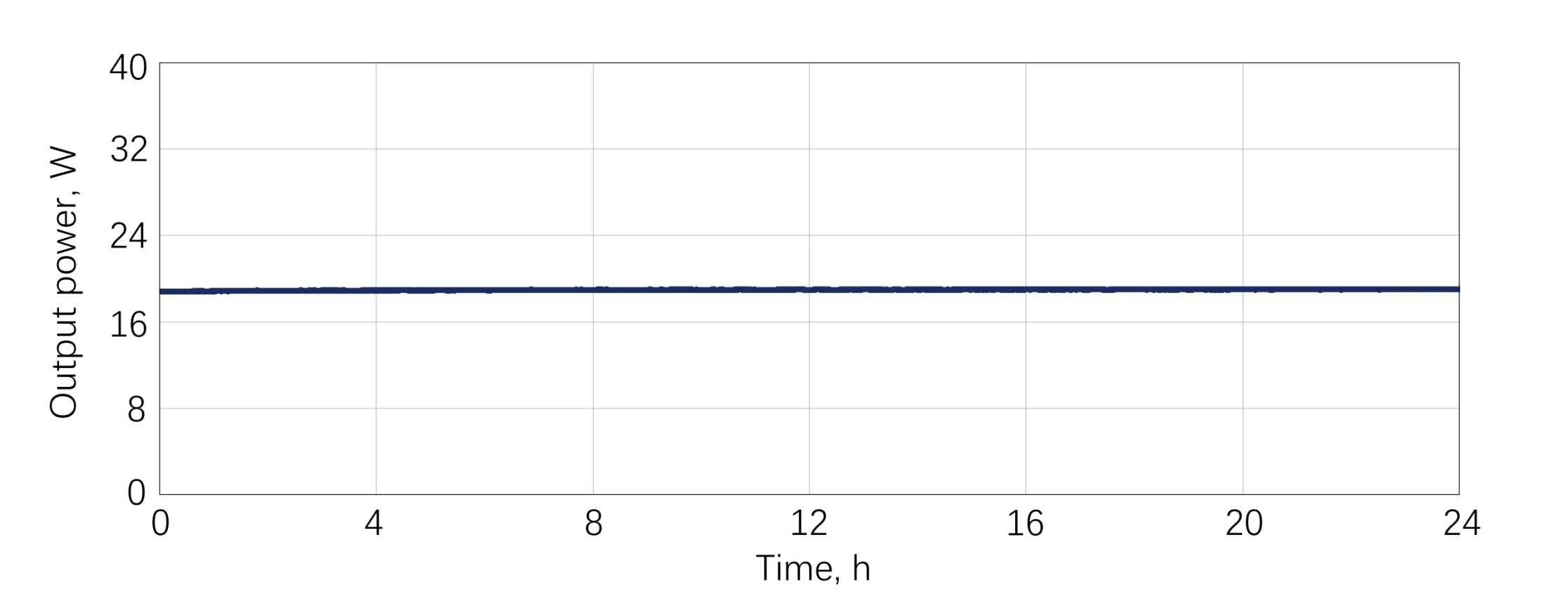 | 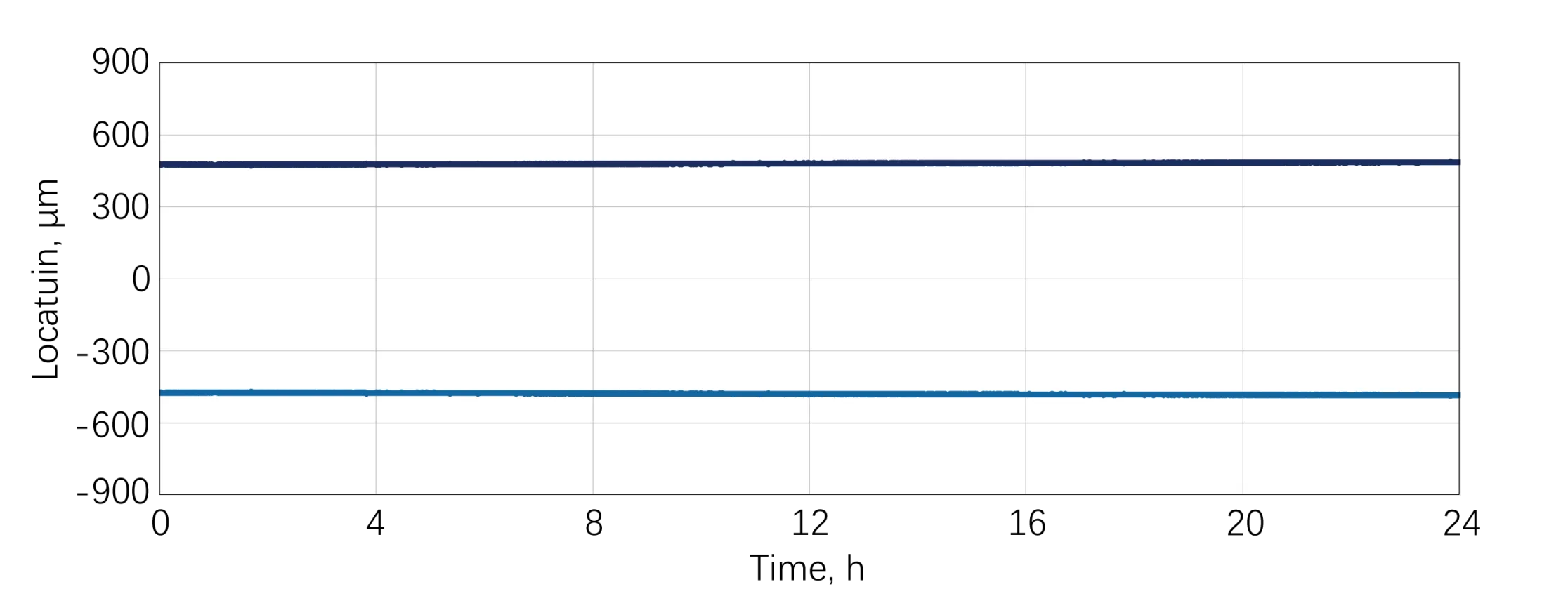 |
HYPERION-G-HE 24-hour long-term power stability — 18.964 W mean · RMS = 0.2554 % (Chuanghuang SN-225101042 thermal head) | HYPERION-G-HE 24-hour pointing stability — F = 450 mm focusing · centroid RMS = 5.06 µm · 11.26 µrad (YLA03-240105 profiler) |
5. One master plus one MPC: from 200 fs to 40 fs
The HELIOS-20W-HE + HYPERION-G-HE combination forms a complete chain from an mJ-class 200 fs Yb femtosecond master to an mJ-class 40 fs few-cycle source — unlocking three experimental modes simultaneously:
Mode A: HHG and EUV coherent sources
1.89 mJ / 40.4 fs / 46.8 GW peak focused onto a gas target raises the HHG cut-off energy E_cutoff ≈ I_p + 3.17 × U_p significantly under sub-50 fs drive, while the mJ-class single-pulse energy ensures useful EUV photon flux. This combination of parameters is precisely what the attoscience and EUV coherent-diffractive-imaging communities have been pursuing for the past decade.
Mode B: Attosecond pulse generation and diagnostics
40 fs / mJ-class 1030 nm drive paired with gas HHG can produce isolated attosecond pulses (few-attosecond regime); the 99 % circular beam profile maps directly onto the CEP-stability requirements of an attosecond streaking camera; and 24-hour 0.2554 % RMS power stability meets the multi-acquisition averaging demands of attosecond physics experiments.
Mode C: Strong-field physics and ultrafast electron diffraction
46.8 GW peak power focused into a ~10 µm spot reaches the 10¹⁵ W/cm² regime — enough to drive strong-field ionization and ultrafast electron diffraction (UED) experiments. M² near the diffraction limit guarantees the focusability that these experiments require.
Three modes on a single master, a single MPC — this is what an industrial Yb femtosecond platform looks like once it has evolved into a benchtop infrastructure for attoscience.
6. Closing thought
2.15 mJ, 226.6 fs, 0.035 % RMS @ 24 h, 95.97 % transmission, 40.4 fs output, 46.8 GW peak power, 99 % ellipticity — these seven numbers from the HELIOS-20W-HE + HYPERION-G-HE chain map cleanly onto the seven physical dimensions a few-cycle femtosecond source actually requires: energy threshold, input pulse duration, long-term stability, energy-transfer efficiency, output pulse duration, peak power, and spatial-mode quality. Miss any one of them and the chain loses engineering margin to drive HHG, attosecond, or strong-field experiments.
Industrial Yb femtosecond lasers should not be confined to 200 fs, and MPC should not be treated as a nice-to-have add-on. Together they form the standard infrastructure for the next generation of few-cycle femtosecond sources. This engineering demonstration — 5× compression, 95.97 % transmission, 46.8 GW peak power — is the quantitative evidence: the mJ-class Yb + MPC post-compression combination has now matured into a platform ready for mainstream attoscience, HHG, and strong-field deployment.