Attosecond Physics and High-Harmonic Generation — How Femtosecond Lasers Open the Gate to 10⁻¹⁸ Seconds
HELIOS-20W-HE、HYPERION-G-HE、AttosecondPhysics hashtag、HHG hashtag、UltrafastLaser
May 19, 2026
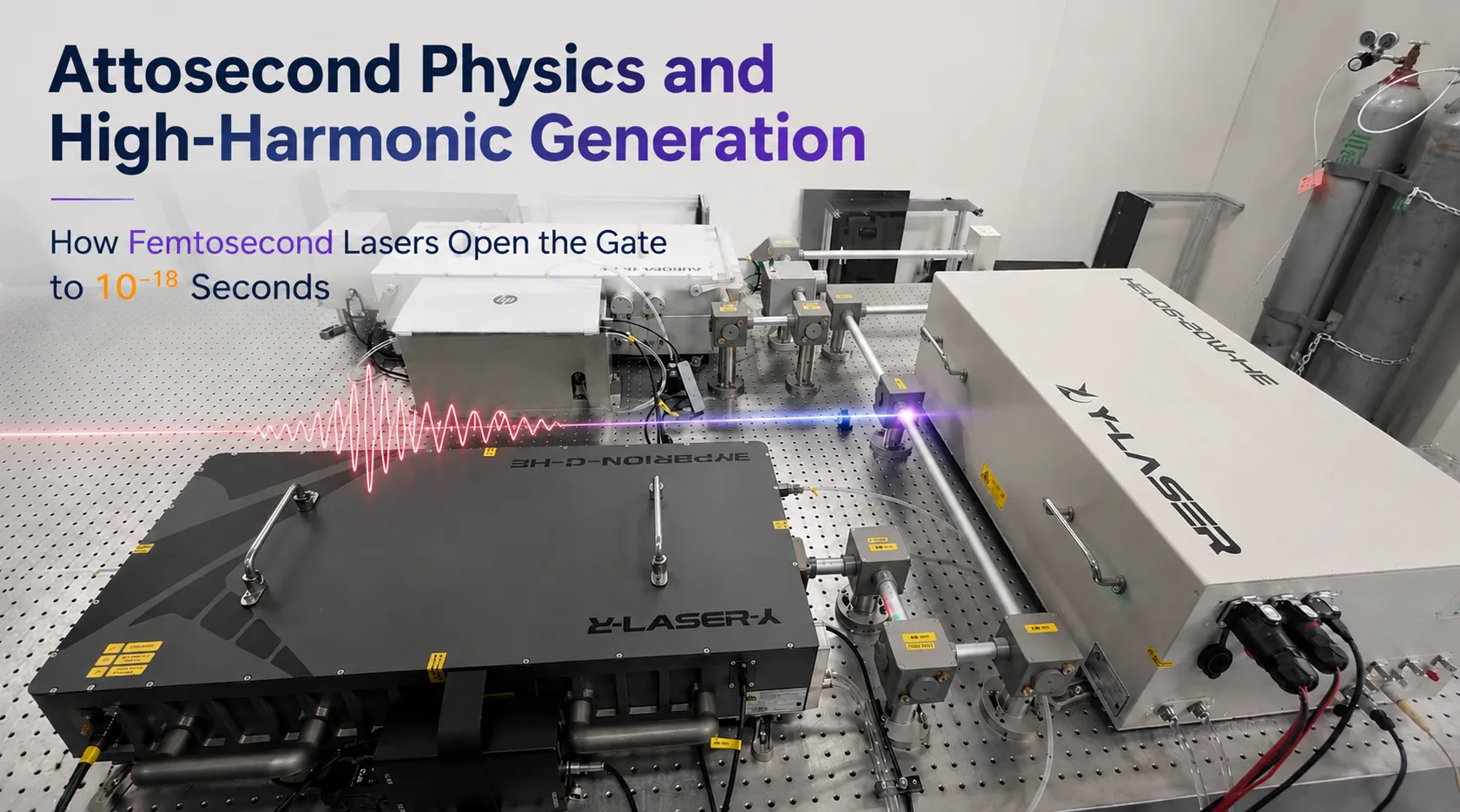
Introduction: 222.6 fs → 32.7 fs → Attoseconds — A Verified Driver Chain
The 2023 Nobel Prize in Physics (L'Huillier, Agostini, Krausz) marked the transition of attosecond science from frontier experiment to industrial-grade application. High-Harmonic Generation (HHG) — the primary route to attosecond pulses — demands mJ-level pulse energy, few-cycle pulse duration, and 0.1% RMS long-term stability from the driving laser.
Y-LASER recently completed delivery and acceptance of a full attosecond driver chain: HELIOS-20W-HE high-energy femtosecond front-end + HYPERION-G-HE gas MPC pulse compressor + AURORA-IR-HE mid-IR OPA. Factory-measured performance: 222.6 fs → 32.7 fs pulse compression (6.8× ratio), peak power from 9.8 GW to 58.7 GW, 96% throughput, 0.1% RMS power stability sustained over 18 hours. Below we trace the HHG physics and present the measured data behind each stage.
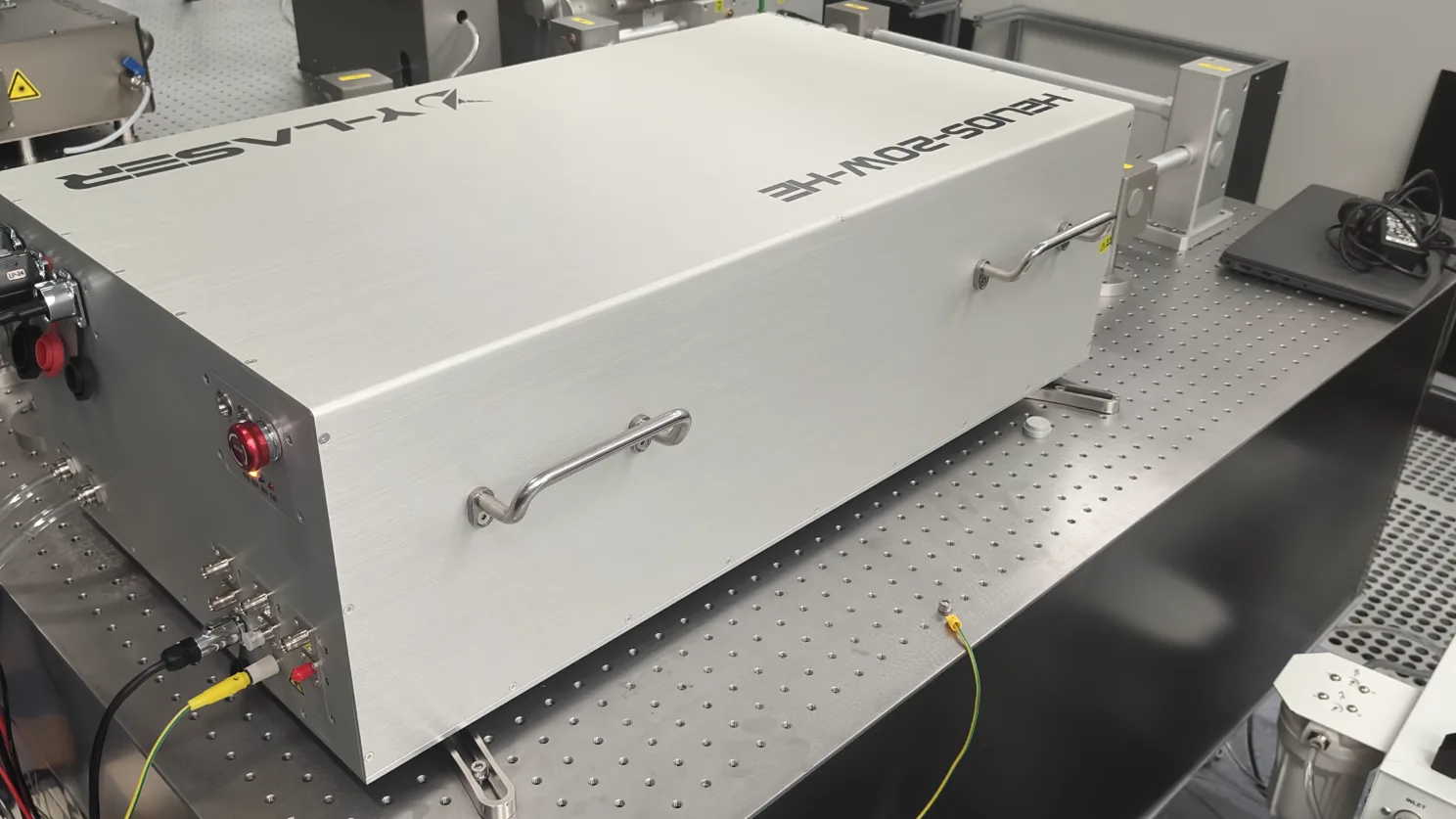 | 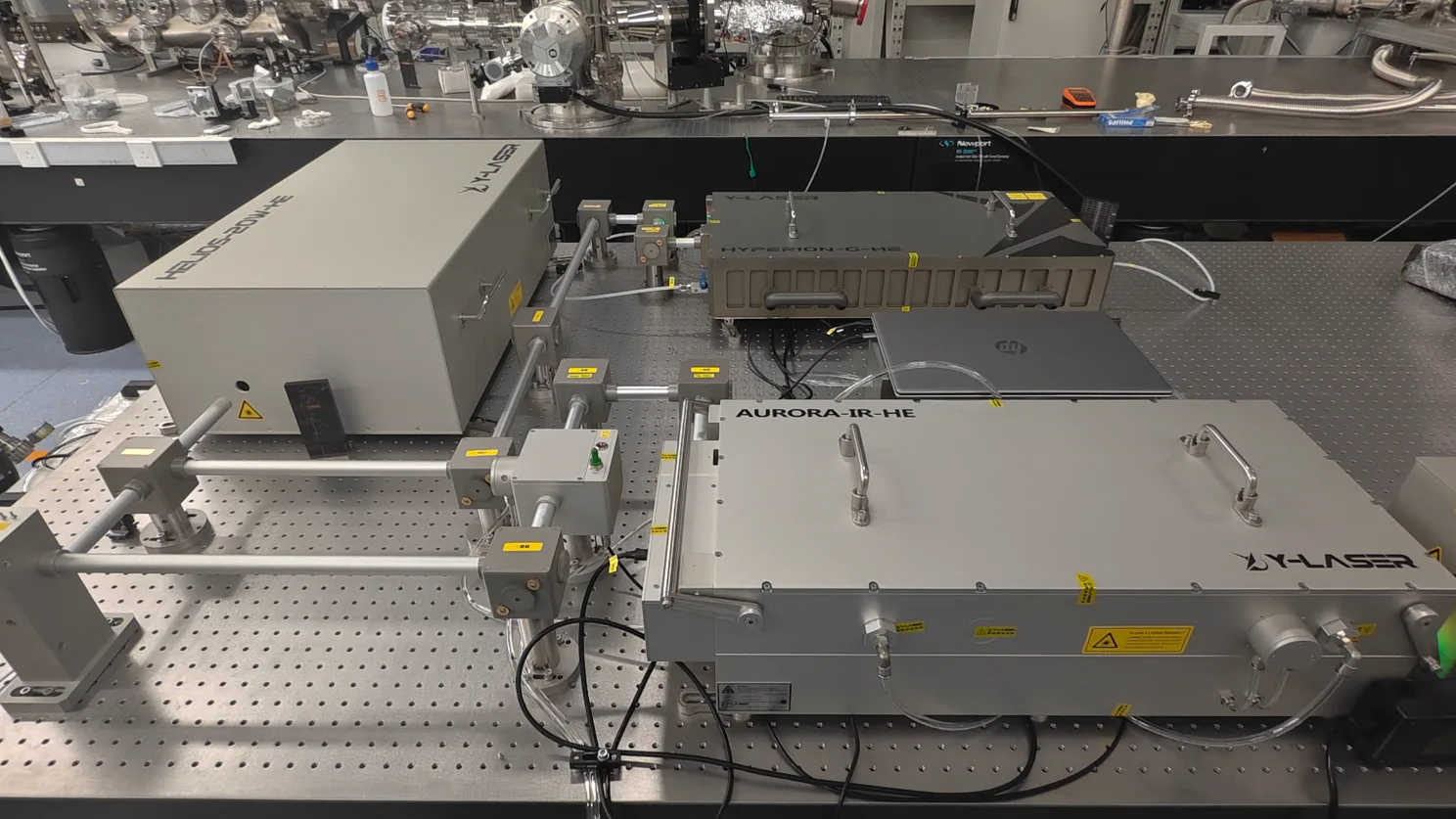 |
HELIOS-20W-HE high-energy Yb femtosecond front-end — on-site delivery | AURORA-IR-HE mid-IR OPA + HYPERION-G-HE gas MPC system — on-site delivery |
1. HHG Three-Step Model: How Attosecond Pulses Are Born
High-Harmonic Generation follows Corkum's (1993) three-step model:
▪ Tunnel ionization: At focused intensities of 10¹³ – 10¹⁴ W/cm², the valence electron tunnels through the Coulomb barrier. This sets a hard threshold on peak power density — pulse energy must reach the mJ level.
▪ Classical acceleration and return: The free electron accelerates in the optical field, reverses, and returns. Return kinetic energy depends on the ionization phase, giving rise to 'long' and 'short' trajectory families.
▪ Radiative recombination: The returning electron recombines with the parent ion, emitting a high-energy photon. Maximum photon energy follows the cutoff law: E_cutoff = I_p + 3.17 U_p, where U_p ∝ I·λ².
Coherent superposition of harmonic lines yields an attosecond pulse train (APT). Gating techniques (polarization gating, CEP-stable few-cycle driving) isolate a single attosecond pulse (IAP).
2. Cutoff Law → Four Hard Specifications for the Driver
Since U_p ∝ I·λ², higher HHG cutoff energy requires either higher intensity (mJ energy + short pulses) or longer wavelength. In engineering terms, these physics constraints translate into four non-negotiable specifications:
2.1 mJ-Level Pulse Energy
Neon targets (I_p = 21.6 eV) require ~5 × 10¹⁴ W/cm² to reach the water window (284 – 543 eV). For a 30 µm spot and 30 fs duration, this means 1 – 2 mJ per pulse. The HELIOS-20W-HE delivers 2.18 mJ measured, clearing this threshold.
2.2 Few-Cycle Pulse Duration
Isolated attosecond pulse generation requires near-few-cycle driving. At 1037 nm, one optical cycle ≈ 3.45 fs; the HELIOS direct output of 222.6 fs spans 64 cycles. The HYPERION-G-HE compresses this to 32.7 fs (~9.5 cycles) — entering the efficient EUV HHG driving regime.
2.3 10 – 100 kHz Repetition Rate
Legacy 1 kHz Ti:Sapphire systems accumulate signal too slowly for modern attosecond experiments. Yb-based lasers push repetition rates to 10 – 100 kHz, boosting data acquisition by 1 – 2 orders of magnitude while reducing per-pulse thermal loading on gas targets (Hädrich et al., 2015, Nat. Photonics 9, 764). The HELIOS-20W-HE supports continuously tunable 10 – 100 kHz.
2.4 Long-Term Stability
HHG is acutely sensitive to parameter drift: 1% power fluctuation causes > 10% harmonic intensity variation in the cutoff region; µrad-level pointing drift degrades phase matching over multi-hour runs. The HELIOS-20W-HE delivers RMS = 0.1% power stability and 4.27 µrad pointing stability — both measured over 18 continuous hours.
3. HELIOS-20W-HE: Femtosecond Front-End — Measured Data
The HELIOS-20W-HE uses all-solid-state Yb chirped-pulse amplification (CPA), directly diode-pumped with only ~9% quantum defect (vs. 34% for Ti:Sapphire). Key measured parameters:
▪ Center wavelength: 1037 nm
▪ Pulse duration: 222.6 fs (Sech² fit, autocorrelation FWHM)
▪ Pulse energy: 2.18 mJ @ 10 kHz
▪ Average power: 21.8 W
▪ Power stability: RMS = 0.1% (18 h continuous)
▪ Pointing stability: 4.27 µrad (18 h continuous)
▪ Beam quality: M²x = 1.115 / M²y = 1.143
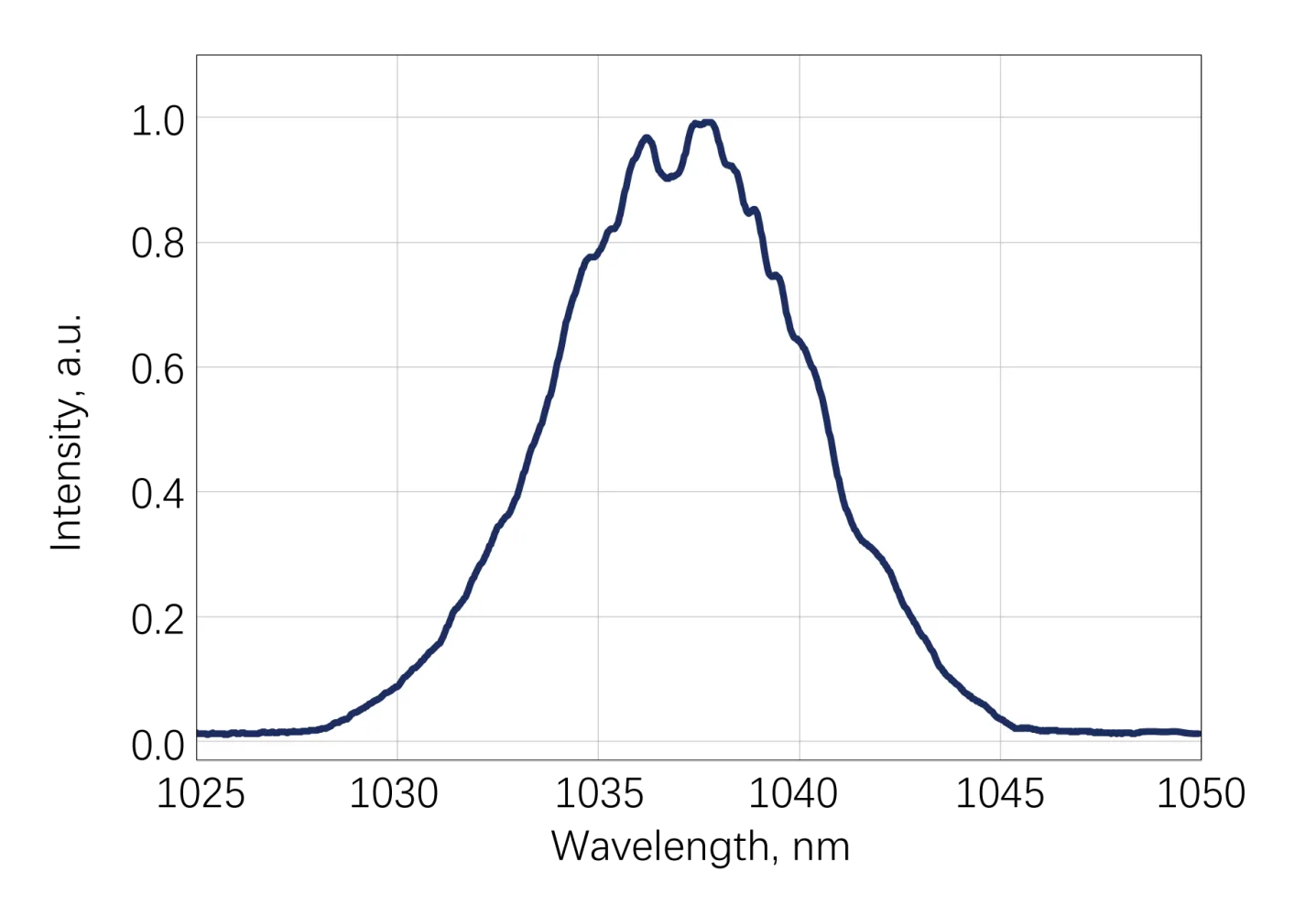 | 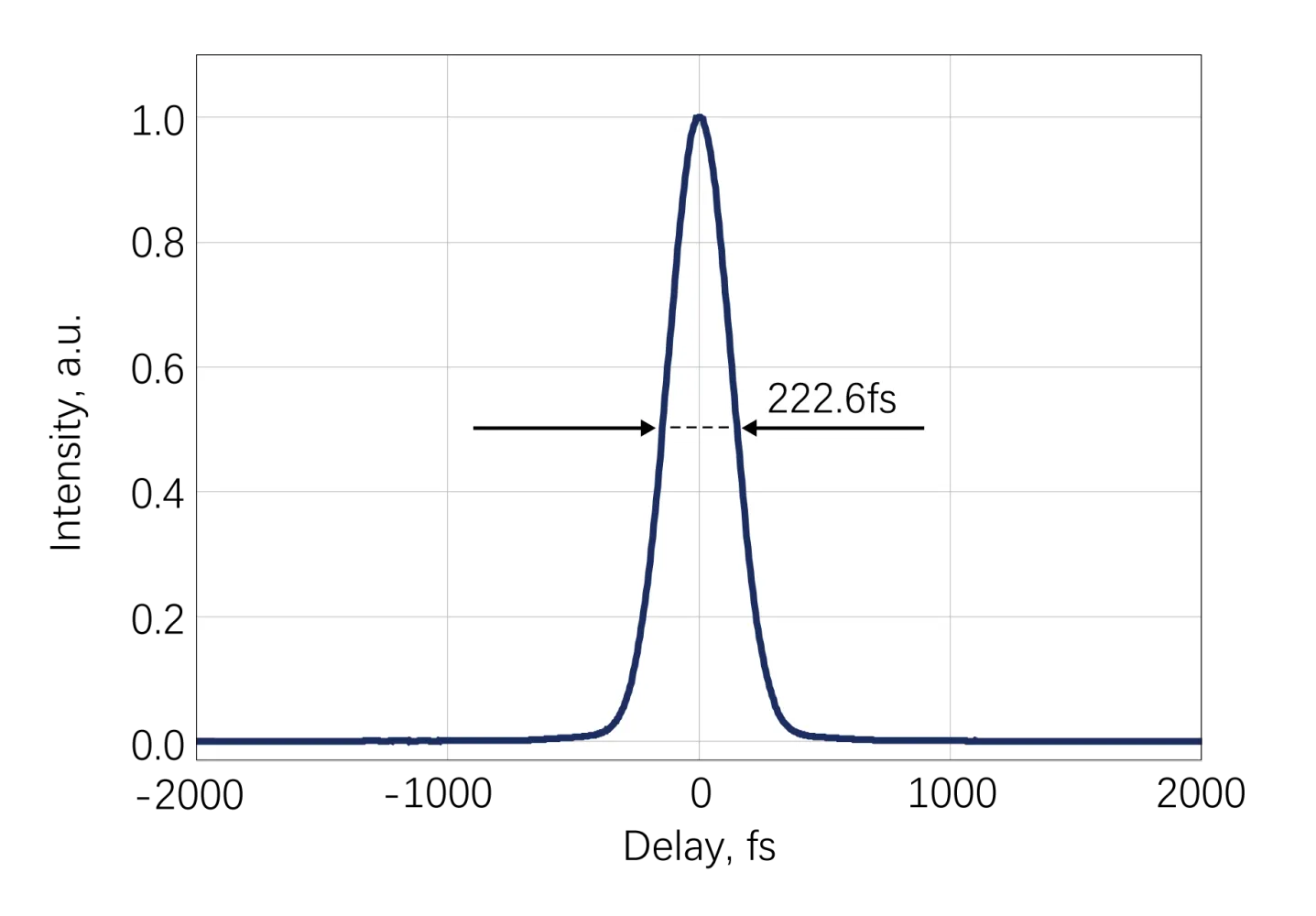 |
HELIOS-20W-HE output spectrum: 1037 nm center wavelength @ 10 kHz | HELIOS-20W-HE autocorrelation: 222.6 fs FWHM @ 10 kHz / 2.18 mJ |
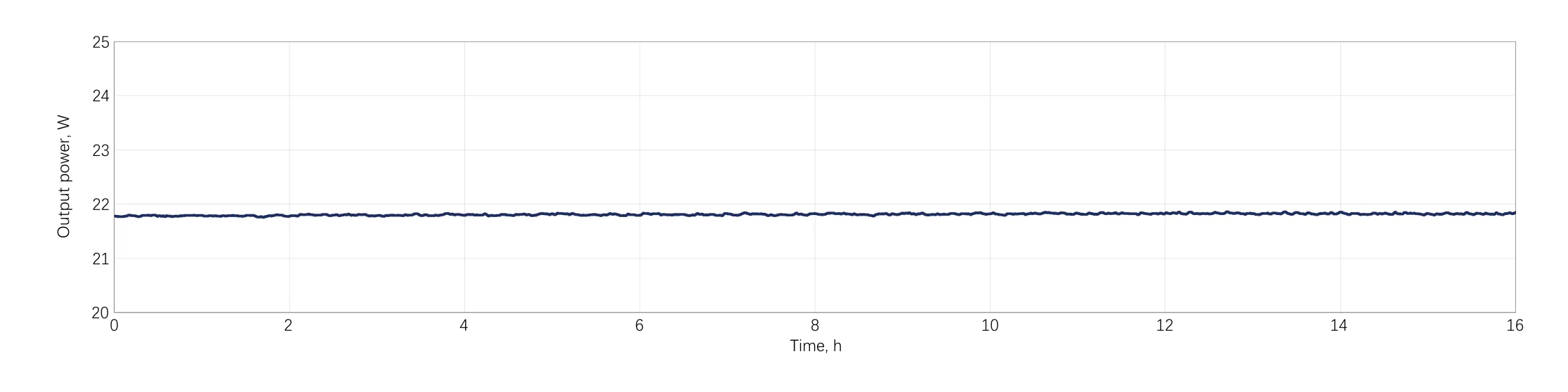
HELIOS-20W-HE power stability: RMS = 0.1% @ 10 kHz / 18 h continuous
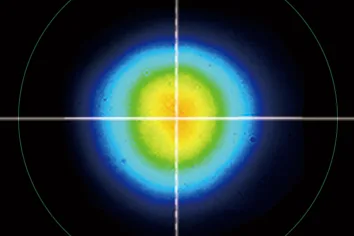
HELIOS-20W-HE near-field beam profile @ 10 kHz
4. HYPERION-G-HE: Gas MPC Pulse Compressor — Measured Data
At 222 fs, the pulse cannot directly drive HHG to the cutoff region. The HYPERION-G-HE solves this via gas-filled multi-pass cell (MPC) nonlinear compression:
▪ SPM spectral broadening: The pulse traverses an Ar/Ne-filled MPC, accumulating self-phase modulation. Spectrum broadens from 14 nm to 93 nm (−10 dB bandwidth, 6.6× expansion), reducing the transform-limited duration to ~20 fs.
▪ Chirped-mirror compression: A precision negative-dispersion mirror set compensates residual chirp, completing temporal compression.
Key measured results:
▪ Input: 222.6 fs / 2.0 mJ → Output: 32.7 fs / 1.92 mJ
▪ Compression ratio: 6.8×
▪ Throughput efficiency: 96% (near-zero energy loss)
▪ Post-compression power stability: RMS = 0.1% (14 h continuous)
▪ Post-compression pointing stability: 6.8 µrad
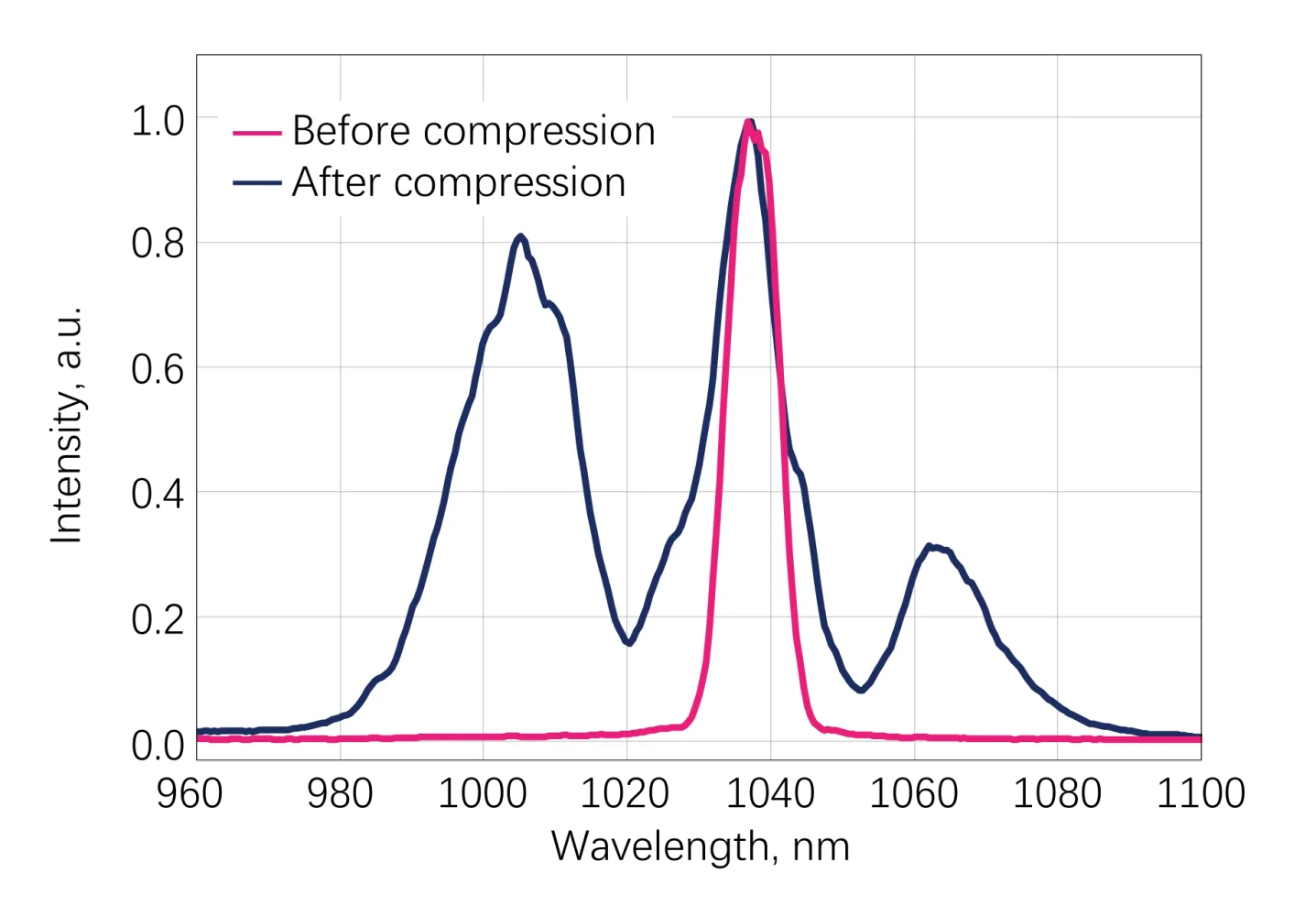 | 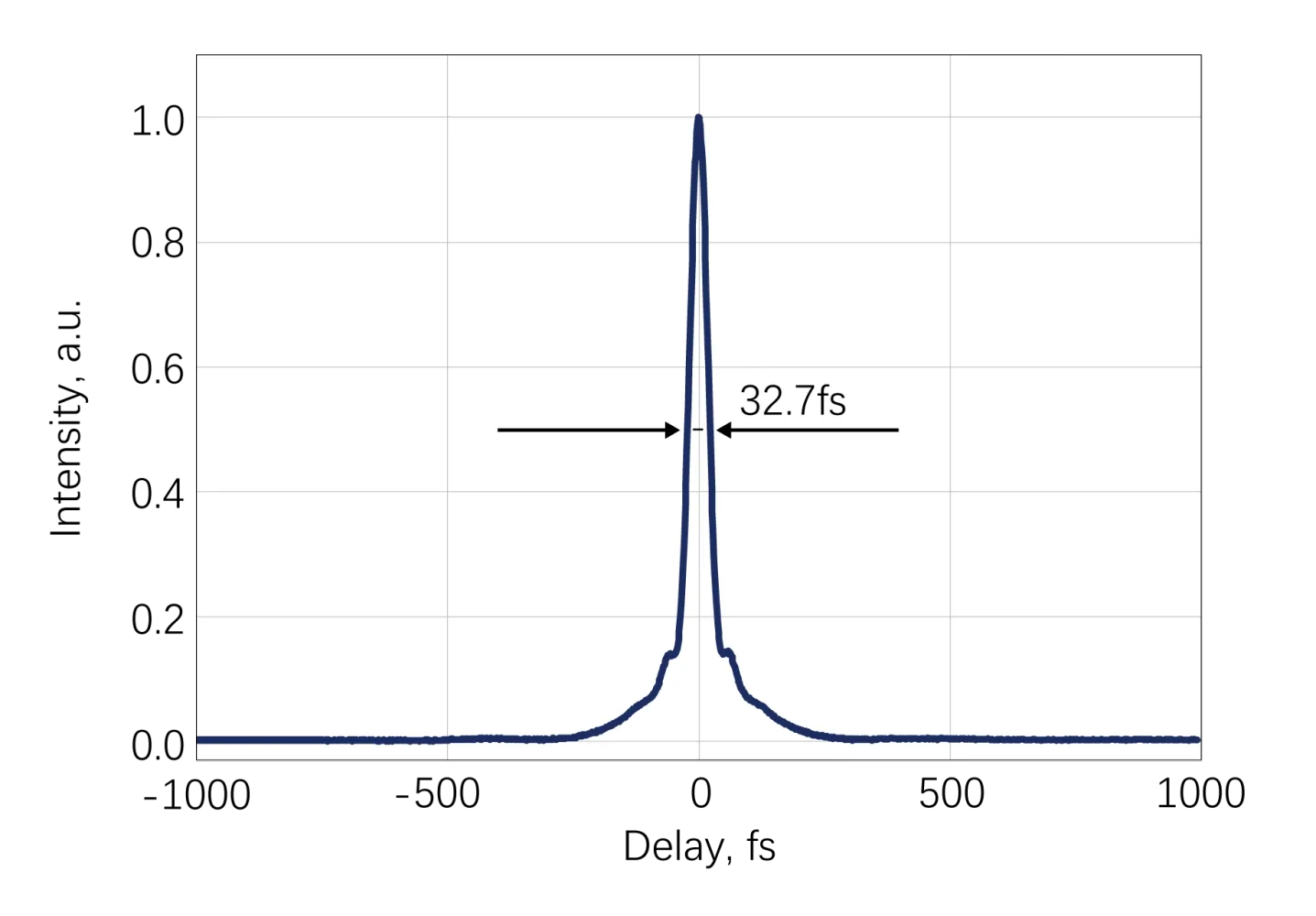 |
HYPERION-G-HE input/output spectra: 14 nm → 93 nm (−10 dB bandwidth) | HYPERION-G-HE compressed pulse autocorrelation: 32.7 fs (Sech² fit) @ 10 kHz / 1.92 mJ |
5. AURORA-IR-HE: Mid-IR OPA Wavelength Extension
The cutoff law (U_p ∝ λ²) means a 2 µm driver yields 4× the cutoff energy of a 1 µm driver, but single-atom HHG efficiency drops as λ⁻⁵ to λ⁻⁶ (Tate et al., 2007, PRL 98, 013901). The AURORA-IR-HE mid-IR OPA covers 1.35 – 4.5 µm continuous tuning for water-window HHG and soft X-ray frontier experiments, and doubles as the core wavelength source for transient absorption spectroscopy (TAS) and time-resolved IR spectroscopy (TRIR).
6. Full-Chain Performance Data

6.8× pulse compression, 6× peak-power gain (9.8 → 58.7 GW), 96% throughput. At 32.7 fs ≈ 9.5 optical cycles (@ 1037 nm), the system enters the efficient EUV HHG driving regime.
7. Why Yb CPA + MPC Is Replacing Ti:Sapphire
Ti:Sapphire offers broad gain bandwidth (direct sub-30 fs output at 800 nm), but its Nd:YAG-pumped architecture caps average power at ~20 W and repetition rate at 1 – 10 kHz. Yb solid-state lasers are directly diode-pumped with only 9% quantum defect (vs. 34%), enabling > 20 W / > 2 mJ at 10 – 100 kHz. The narrower Yb gain bandwidth is offset by MPC compression — HYPERION-G-HE's 32.7 fs matches Ti:Sapphire's direct output.
This 'Yb CPA + Gas MPC' architecture is now adopted by leading attosecond groups worldwide: LIDYL (France), MBI (Germany), Lund University (L'Huillier's group, Sweden). Y-LASER's HELIOS + HYPERION-G-HE delivers equivalent capability as a domestically manufactured, turnkey solution — 0.1% RMS stability over 18 hours, ready to run.
8. Summary
222.6 fs → 32.7 fs → attoseconds. Every step backed by measured data. Y-LASER's mission: let attosecond researchers focus on the physics, not the laser.