Transient Grating Spectroscopy
A four-wave mixing technique in which two pump pulses create an interference grating in the sample, and a probe beam diffracts from this grating to monitor ultrafast dynamics such as carrier diffusion, acoustic phonon propagation, and energy transfer.
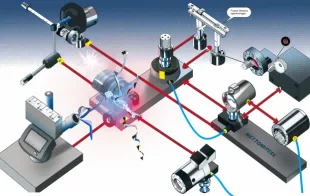
Transient Grating Spectroscopy (TGS) is a technique that uses nonlinear optical effects to study the dynamic processes of materials. In a TGS experiment, two or more coherent femtosecond laser pulses form a transient grating structure in the sample, which can excite and probe various dynamic processes in the sample, such as heat conduction, acoustic wave propagation, and electron motion. These processes usually occur on very short timescales, thus requiring high time resolution for observation.
Femtosecond lasers play a vital role in TGS experiments. The ultrashort pulses they provide enable precise formation of the transient grating and capture of the material’s immediate response to grating formation. These ultrashort pulses not only have extremely high temporal precision but also provide sufficient light intensity to excite significant nonlinear effects, thereby revealing the internal dynamic characteristics of the material.
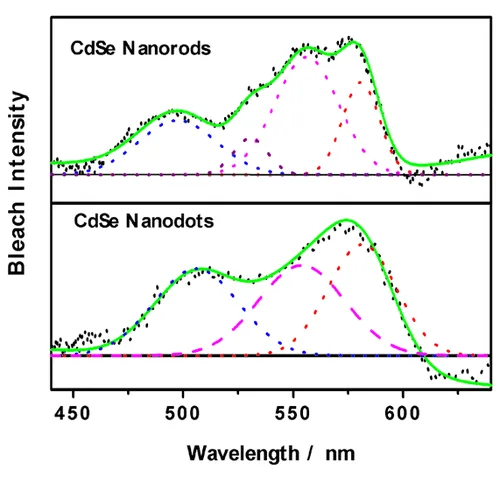
Figure: Comparison of the time dependence of bleach recovery of CdSe nanorods versus nanodots using femtosecond pump-probe transient spectroscopy.
TGS has broad applications in studying the thermodynamic properties of materials. For example, TGS experiments can measure the thermal diffusivity and phonon dynamics of materials, providing deep understanding of their heat-conduction characteristics. This technique is significant for developing efficient thermal-management systems and improving the thermal performance of materials. In condensed-matter physics and materials science, TGS is used to study the interactions between electrons and phonons, providing important information about the electronic structure and physical properties of materials.
With the continuous development of femtosecond laser technology, the time resolution of TGS has improved significantly, enabling scientists to study material dynamic processes on extremely short timescales. In addition, the application of femtosecond lasers in TGS is not limited to traditional thermodynamic research; it is also used to explore the optical and electronic properties of new materials, including two-dimensional materials such as graphene, transition-metal dichalcogenides, and nanomaterials such as quantum dots.
Overall, TGS combined with femtosecond lasers provides a powerful tool for studying the internal dynamic characteristics of materials, with far-reaching impact on both scientific research and industrial applications.