Time-Resolved Fluorescence Spectroscopy
A technique that measures the time-dependent decay of fluorescence emission after pulsed excitation, providing direct access to excited-state lifetimes, energy transfer, and solvent relaxation dynamics.
Time-Resolved Fluorescence Spectroscopy (TRFS) is a powerful molecular spectroscopy tool that uses short-pulse light (such as femtosecond or picosecond lasers) to excite a sample and measures the decay of the fluorescence subsequently emitted by the sample over time. This technique can provide deep information on the molecular environment and molecular dynamics, enabling researchers to gain insight into how molecules interact with their surroundings.
In biochemistry and biophysics, TRFS is widely used to study the structural dynamics of proteins, enzyme reaction mechanisms, and the interactions between biomacromolecules such as proteins and nucleic acids. Through this technique, scientists can observe the dynamic changes during protein folding, unfolding, and binding with other biomolecules, which is significant for understanding the function of biomolecules and the molecular mechanisms of disease.
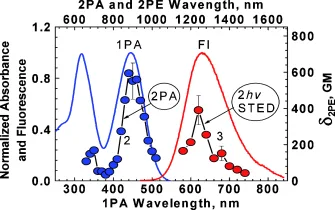
Figure: One- and two-photon excitation emission spectra of a novel fluorene derivative obtained over a broad spectral range, and a new time-resolved fluorescence emission spectroscopy method is proposed.
In materials science, TRFS is crucial for studying the photophysical properties of optoelectronic materials. It plays a key role in studying semiconductors, quantum dots, and organic light-emitting materials, especially in developing new optoelectronic devices and light-energy conversion materials; through this technique, scientists can gain deep understanding of the excited-state lifetime, energy-transfer processes, and electronic dynamics of these materials, thereby optimizing their performance.
The use of femtosecond lasers greatly enhances the capabilities of TRFS. Their ultrashort pulse width enables scientists to precisely excite molecules and capture extremely fast molecular processes such as photoinduced electron transfer and fast chemical reactions. This high-time-resolution measurement capability provides a new perspective for studying photoactivation processes and photoinduced dynamic events. In addition, the precise control capability of femtosecond lasers — including the adjustment of pulse energy, duration, and wavelength — is crucial for studying systems with complex excited-state dynamics.
In summary, time-resolved fluorescence spectroscopy combined with the advantages of femtosecond lasers provides a unique and powerful method for studying the dynamics of molecules and materials.