Femtosecond Stimulated Raman Spectroscopy
A time-resolved vibrational spectroscopy technique that uses a femtosecond pump pulse to initiate dynamics and a narrowband Raman probe to detect vibrational coherence with high temporal and spectral resolution.
Femtosecond Stimulated Raman Scattering Spectroscopy (FSRS) is a revolutionary molecular spectroscopy method that uses the extremely high time resolution of femtosecond laser pulses to study molecular dynamics and structural changes. This technique excites the sample and uses another laser pulse to induce the Raman scattering process, thereby collecting key information about molecular vibrational states and dynamics. A notable feature of FSRS is its ability to capture fast chemical and molecular dynamic processes that traditional Raman spectroscopy cannot observe.
In chemistry research, FSRS is used to study the mechanisms of various complex chemical reactions, especially those involving short-lived intermediates and fast energy transfer. Through in-depth understanding of these fast reaction processes, FSRS can help scientists better understand and control chemical reactions, providing an important basis for developing new drugs, optimizing energy-conversion technologies, and designing new materials.
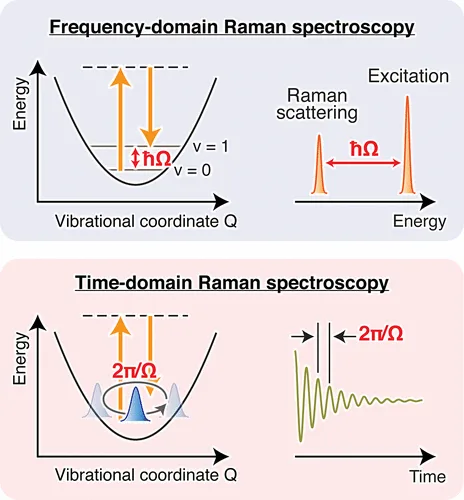
Figure 1: Schematic of frequency-domain and time-domain Raman spectroscopy.
In biochemistry and biophysics, FSRS likewise plays an important role. It can conduct in-depth studies of the dynamic structural changes of biomacromolecules such as proteins, for example the structural changes at active sites during enzyme catalysis, and the molecular dynamics during protein folding and unfolding.
The high time resolution of FSRS is its greatest advantage. By precisely controlling the timing of excitation and probe pulses, FSRS can observe fast dynamic processes inside molecules with femtosecond or picosecond time resolution. This precise time control is crucial for understanding and measuring rapidly changing molecular dynamics and chemical reaction processes, especially when studying extremely short-lived intermediates and fast energy-transfer processes.
Overall, with its unique time resolution and flexibility, FSRS has unmatched advantages in revealing the dynamics and structural characteristics of complex molecular systems, making it increasingly important in today’s scientific research.