Ultrafast Electron Microscopy
A technique that combines femtosecond laser excitation with pulsed electron beams to image transient structural dynamics (e.g., lattice vibrations, phase transitions) with both sub-picosecond temporal resolution and nanometer spatial resolution.
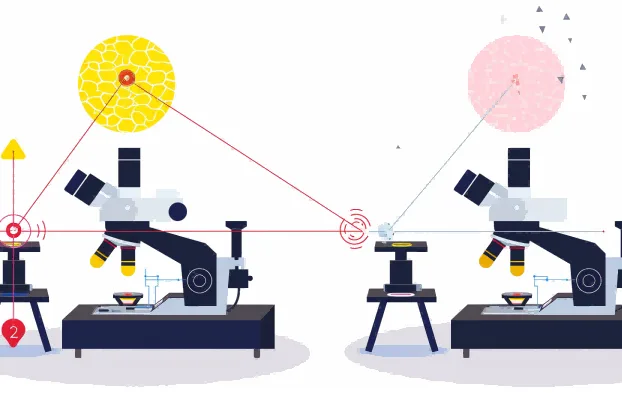
The Ultrafast Electron Microscope (UEM) is an advanced microscopic imaging technology that combines femtosecond laser technology with traditional electron microscopy. Its key feature is using a femtosecond laser to excite the sample and capturing the ultrafast electron fluctuations in the sample through the electron microscope, thereby achieving ultrahigh-time-resolution observation of materials or biological samples. This technology can reveal the dynamic changes of materials and biological samples on extremely short timescales, providing an unprecedented perspective for scientific research.
In UEM technology, the application of the femtosecond laser is crucial. First, femtosecond laser pulses are used to excite the sample; their extremely short pulse duration (usually a few to tens of femtoseconds) can trigger ultrafast dynamic processes in the sample, including electron redistribution and instantaneous changes in molecular structure. Second, by precisely controlling the timing and energy of the laser pulses, scientists can achieve fine control of the sample’s excitation state. This enables UEM to capture detailed electron behavior in the sample at different time points, achieving high-time-resolution observation of dynamic processes.
In materials science, UEM has very broad applications. It can be used to observe the structural dynamic changes of nanomaterials after being excited by laser pulses. This is crucial for understanding and studying the mechanisms of material physical-property changes, such as changes in conductivity, magnetism, and optical properties. In chemistry, UEM can reveal the intermediate states of chemical reactions, helping scientists gain deep understanding of complex chemical reaction processes.
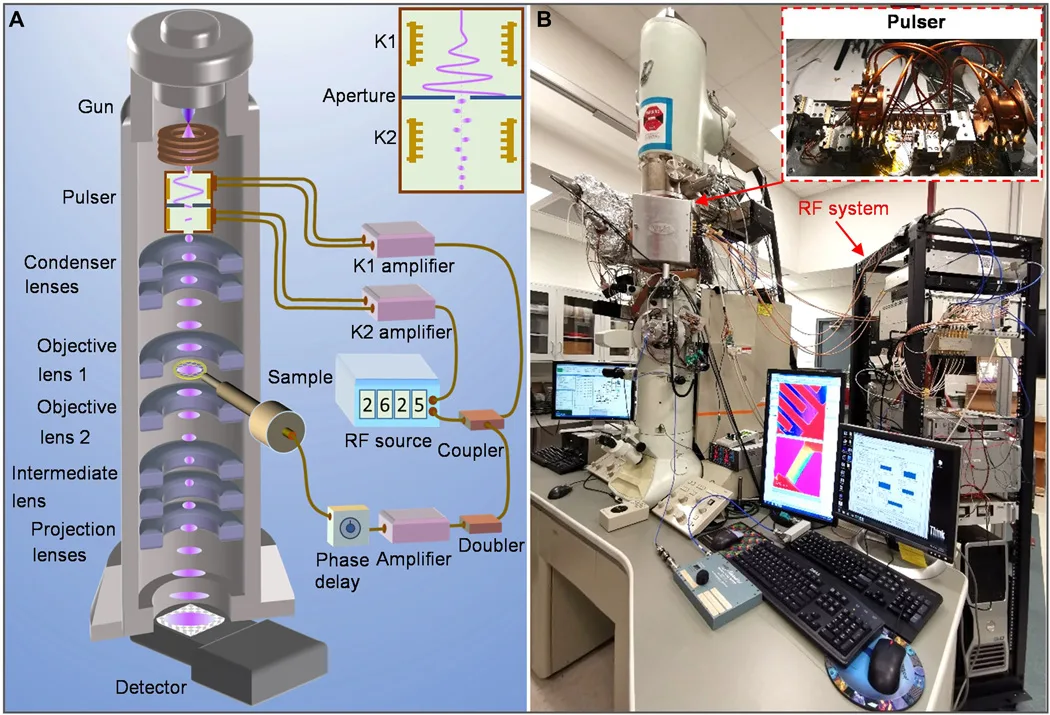
Figure 1: A laser-free UEM system.
In biology applications, the role of UEM is equally significant. It can be used to study the dynamic changes of biomacromolecules and intracellular structures under laser excitation. Such observation helps reveal the microscopic mechanisms in life processes, such as protein folding and the dynamic changes of organelles.
The role of the femtosecond laser in UEM technology is not limited to serving as the excitation source. It is also key to achieving ultrahigh-time-resolution observation. The high controllability and precision of the femtosecond laser give UEM great flexibility and repeatability in experiments. In addition, UEM has the advantage of high spatial resolution, providing fine information about sample structure.