Three-Photon Microscopy
A deep-tissue imaging technique that uses three near-infrared photons for simultaneous excitation, significantly reducing scattering and background fluorescence, enabling high-resolution imaging at depths beyond the reach of two-photon microscopy.
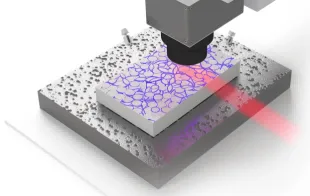
Nonlinear microscopy is an advanced microscopic imaging technology based on nonlinear optical effects, and has become a major breakthrough in modern microscopy. This technology mainly relies on nonlinear effects such as two-photon absorption, three-photon absorption, and harmonic generation (including second and third harmonics), which occur only under extremely high light intensity. Therefore, it usually requires a light source with short pulses and high peak power produced by a femtosecond laser.
The key advantage of the femtosecond laser lies in the ultrashort pulses and high peak power it provides. These characteristics enable the femtosecond laser to locally excite and produce strong nonlinear optical signals without damaging the sample, used to construct high-resolution microscopic images. This technology is especially notable in biomedicine. Using femtosecond lasers, researchers can observe the cellular and molecular structures of living tissue without relying on traditional staining or fixation techniques.
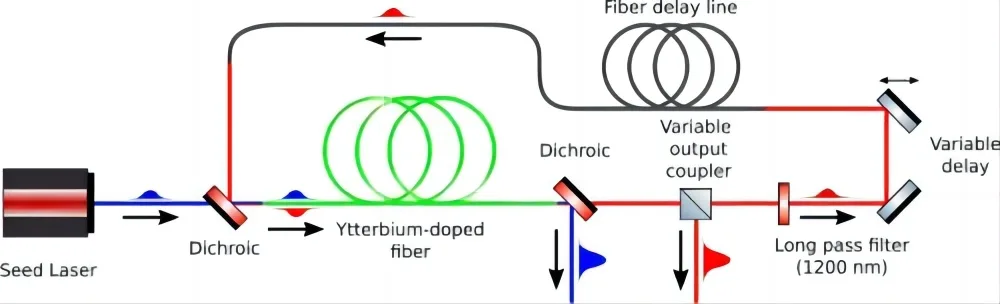
Figure 1: Conceptual diagram of a synchronously pumped Raman laser. The seed laser and ytterbium-doped fiber alone form the gain-managed nonlinear amplifier, and the rest of the system provides positive feedback at wavelengths above 1200 nm.
In materials science, nonlinear microscopy likewise shows strong potential. It is widely used to analyze the microstructure of various materials, such as crystals, polymers, and nanomaterials. By using nonlinear optical effects, scientists can obtain detailed information about the internal structure and properties of materials.
The use of femtosecond lasers not only improves imaging depth and resolution, but because of the high locality of nonlinear effects, femtosecond lasers can precisely excite tiny regions of the sample, obtaining clearer and more detailed images. In addition, the brevity and high peak power of femtosecond laser pulses greatly reduce thermal damage and photobleaching of the sample, which is especially important for imaging sensitive samples or living tissue.
In particular, the application of femtosecond lasers in nonlinear microscopy is not limited to imaging biological tissue. In fields such as nanotechnology, optoelectronics, and quantum physics, femtosecond lasers also demonstrate unmatched capabilities. For example, using femtosecond lasers for nonlinear microscopic imaging can reveal charge-transfer processes inside nanomaterials, the dynamic behavior of photoelectrons, and the optical properties of quantum dots.