CARS and SRS Microscopy
A nonlinear vibrational imaging technique that uses a pump–Stokes–probe four-wave mixing process to generate a resonant anti-Stokes signal, enabling label-free chemical mapping with high speed and intrinsic vibrational contrast.
Coherent Anti-Stokes Raman Scattering (CARS) and Stimulated Raman Scattering (SRS) are advanced techniques based on nonlinear spectroscopy, widely used in chemistry, biomedicine, materials science, and more.
The basic principle of CARS and SRS is to irradiate the sample with two or more laser beams of different frequencies (usually a pump beam and a Stokes beam). In CARS, when the frequency difference between the pump and Stokes beams matches the frequency of a molecular vibrational mode in the sample, new light at the anti-Stokes frequency is produced. The intensity of this new-frequency light is proportional to the concentration of the specific molecule in the sample. SRS focuses on the enhancement or attenuation of the Stokes or pump light, which is caused by energy transfer of molecular vibrational modes in the sample.
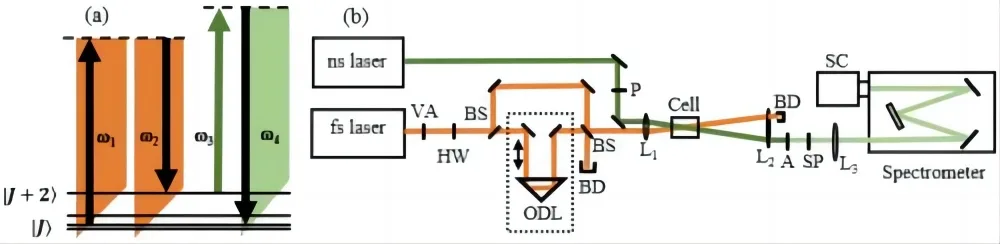
Figure 1: (a) energy diagram of RCARS, and (b) schematic of the experimental setup.
Femtosecond lasers play a key role in both techniques. Femtosecond lasers can produce extremely short pulse widths and high peak power, which is crucial for producing nonlinear signals of sufficient intensity. In CARS, the high peak power of the femtosecond laser greatly enhances the nonlinear signal, improving the signal-to-background-noise ratio and thereby enhancing detection sensitivity. Meanwhile, the ultrashort pulses of the femtosecond laser allow precise time-resolved measurements, which is very important for studying fast dynamic processes (such as chemical reactions and changes in the state of matter).
CARS and SRS have very broad applications in chemistry and biomedicine. These techniques can be used to observe molecular processes inside living cells in real time, such as the dynamic distribution of proteins and lipids, as well as the transport and distribution of drug molecules within cells. In addition, they are also used to study the chemical composition and structural changes of materials, especially at the nanoscale.
In fields such as drug development, disease diagnosis, and environmental monitoring, CARS and SRS technologies demonstrate great application potential. Through these techniques, scientists can conduct non-invasive, high-spatial-resolution research, providing a new perspective for understanding and manipulating the electronic properties of materials.