Synchrotron Locking and Synchronization
Precisely synchronizing the ultrafast laser with large-scale facilities (such as free-electron lasers) to enable pump-probe experiments.
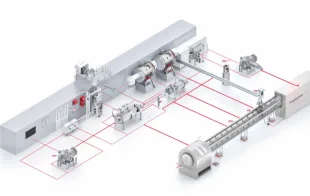
In particle accelerators and laser experiments, precise synchronization of multiple systems and components is crucial. This synchronization involves not only the temporal alignment of particle beams and laser pulses but also the precise control of other experimental parameters. To achieve this, high-precision clock systems are usually required to synchronize different parts of the experimental facility. The stability and precision of these clock systems are crucial to the success of experiments.
In particle accelerator experiments such as the Large Hadron Collider (LHC), synchrotron locking technology is used to precisely control the timing of particle collisions. This synchronization ensures that particle beams arrive at the collision point at the correct moment, allowing scientists to observe and record the results of particle interactions. In addition, precise time control helps improve the collision frequency and energy resolution of the collider, gaining more insight across various fields of physics.
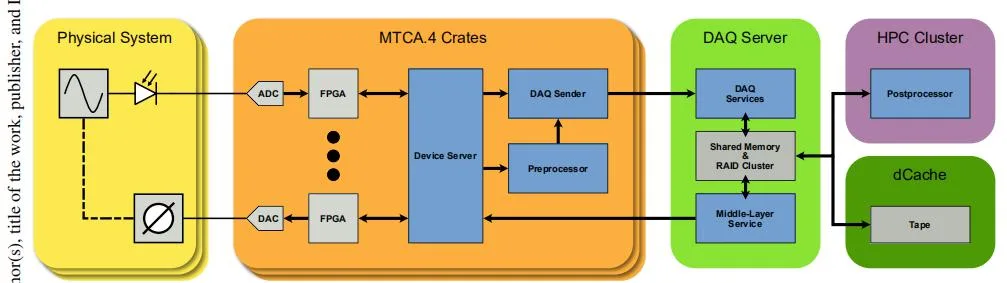
Figure: Synchrotron data-acquisition workflow.
In laser-driven nuclear fusion and other high-intensity laser experiments, synchronization and precise control of laser pulses are equally crucial. Precisely controlling the timing of laser pulses can not only ensure maximum energy transfer to the target material but also achieve correct excitation, thereby improving experimental efficiency and success rate.
Femtosecond lasers play a key role in these experiments because they can produce extremely stable and repeatable pulses. These pulses can serve as time references in experiments, helping achieve high-precision time synchronization. The high precision and repeatability of femtosecond lasers make them an ideal tool for achieving precise time control.
For example, synchronizing laser pulses with accelerated particle beams can greatly improve the accuracy and reliability of experiments, especially in experiments requiring synchronization on extremely short timescales. The application of femtosecond lasers in these applications not only improves experimental accuracy but also offers new possibilities for scientific research in fields such as quantum physics, high-energy physics, and materials science.
In summary, high-precision synchronization technology plays a vital role in particle accelerators and laser experiments. As a key tool in these experiments, the stability and precision of femtosecond lasers are crucial for achieving high-precision time control and synchronization.