Laser Pump and Seed Sources
Providing the "spark" (seed) and the "power" (pump) for subsequent amplification, this determines the basic performance parameters of the system.

Laser pumping is a key process for achieving laser emission; it provides energy to excite the laser medium so that its atoms or molecules reach an excited state, thereby producing laser light. This excitation can be achieved through optical pumping (using another laser) or electrical pumping (using electric current). In optical and electrical pumping, the excitation sources and methods differ, but the ultimate goal is to achieve efficient and stable laser output.
Optical pumping is a common excitation method in which an external light source (such as a femtosecond laser) is used to excite the laser gain medium. Femtosecond lasers are especially suitable for optical pumping because they can produce extremely short pulses that help effectively excite the atoms or molecules in the gain medium to the excited state. This excited state is key to producing laser light. Femtosecond laser pumping technology is especially important in experimental physics, medical applications, and industrial processing, because it can provide precise energy control and efficient excitation.
In electrical pumping, current is directly used to excite the laser medium. This method is widely used in solid-state lasers and certain types of semiconductor lasers. Electrical pumping provides a relatively simple and efficient excitation method, especially suitable for the design of continuous-wave (CW) and long-pulse lasers.
Seed injection is another technique for improving laser quality and coherence. By introducing a low-power but high-quality laser beam (seed beam) into a more powerful laser, the characteristics of the output laser — such as wavelength, phase, and mode structure — can be precisely controlled. This technique is crucial in high-precision optical measurement, spectroscopy, optical fiber communication, and lidar.
Because of the unique ultrashort-pulse and high-peak-power characteristics of femtosecond lasers, they are very suitable as light sources for laser pumping, especially in applications requiring high-precision time control. Femtosecond lasers can provide precise energy transfer and efficient excitation when pumping specific types of laser gain media, which is crucial for achieving complex optical effects and precision machining.
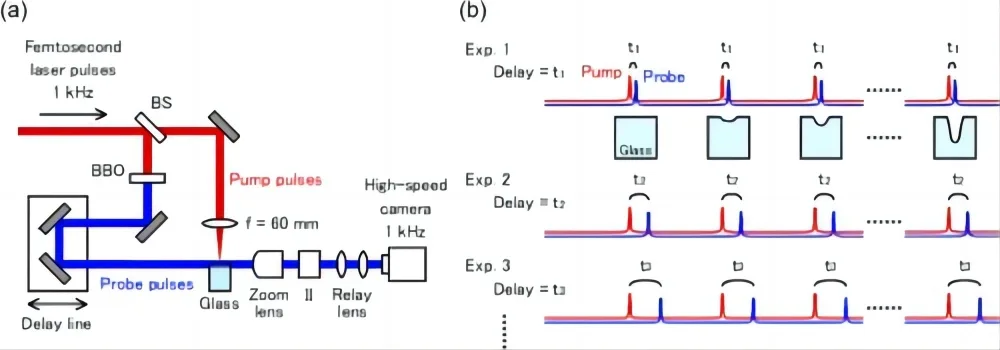
Figure: (a) Optical setup of the experiment. Both the femtosecond laser and the high-speed camera operate synchronously at 1 kHz. BS: beam splitter; II: image intensifier. (b) Illustration of pump-probe imaging combined with a high-speed camera.
The beam produced by the femtosecond laser has extremely high coherence and stability, making it an ideal choice for seed-injection technology. Using a femtosecond laser as the seed source can ensure that the resulting laser output has a high degree of quality and stability, which is crucial for achieving high-precision scientific experiments and industrial processing.
In summary, laser pumping technology plays a vital role in achieving laser emission. Whether optical pumping, electrical pumping, or seed-injection technology, each has its own unique advantages and application scenarios. As an efficient and precise pumping source, the femtosecond laser is of increasing importance in the development of laser technology.