Laser-Induced Periodic Surface Structures (LIPSS)
Periodic surface structures refer to regular, repeated patterns—typically with sub-wavelength or micro-scale periods—formed on material surfaces by ultrafast laser irradiation, often via interference or self-organization effects. These structures are widely used to tailor surface properties such as wettability, color, antireflectivity, and friction.
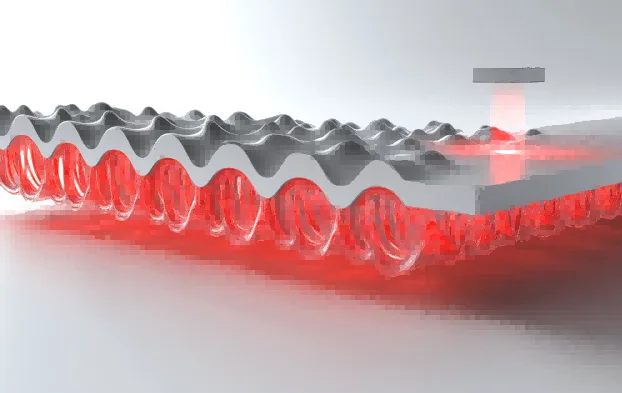
A periodic surface structure is a phenomenon in which regular micro- or nanoscale structures form on the surface of a material. Such structures are usually produced by laser irradiation of a solid surface, especially when using short-pulse lasers such as femtosecond lasers.
The formation of periodic surface structures is based on the complex physical processes of laser–material interaction, including optical interference, local field enhancement, thermal effects, and nonlinear optical effects. The high-intensity optical field produced by a femtosecond laser at the material surface interacts with the surface to form an optical interference pattern. This interference pattern drives local structural rearrangement of the material under the optical field, forming a periodic surface structure. The ultrashort pulses and high peak power of the femtosecond laser generate strong nonlinear optical effects at the surface, such as multiphoton absorption and plasma generation, which help precisely modify the surface structure.
The process first requires selecting a suitable material, such as a metal, semiconductor, or polymer. The surface of these materials must be clean to ensure processing precision. The periodicity of these structures is usually related to the wavelength of the incident laser, but it can also be tuned through femtosecond laser parameters such as pulse duration, energy density, repetition rate, and scanning speed. These parameters affect processing precision and the characteristics of the periodic structures. The femtosecond laser scans the material surface; the laser–material interaction produces small structural changes on the surface, forming a periodic pattern. After processing, microscopy or other imaging techniques are used to inspect the surface structure and confirm that the desired periodic pattern has formed.
LIPSS can not only change the surface morphology of a material but also improve its optical, electrical, and mechanical properties, giving it potential application value in many fields; it is widely used for surface functionalization of various materials. In optoelectronics, LIPSS can be used to enhance light absorption or reduce reflection, thereby improving the efficiency of solar cells and photodetectors. In biomedicine, forming specific nanoscale LIPSS can improve the cytocompatibility and bioactivity of biomaterials.
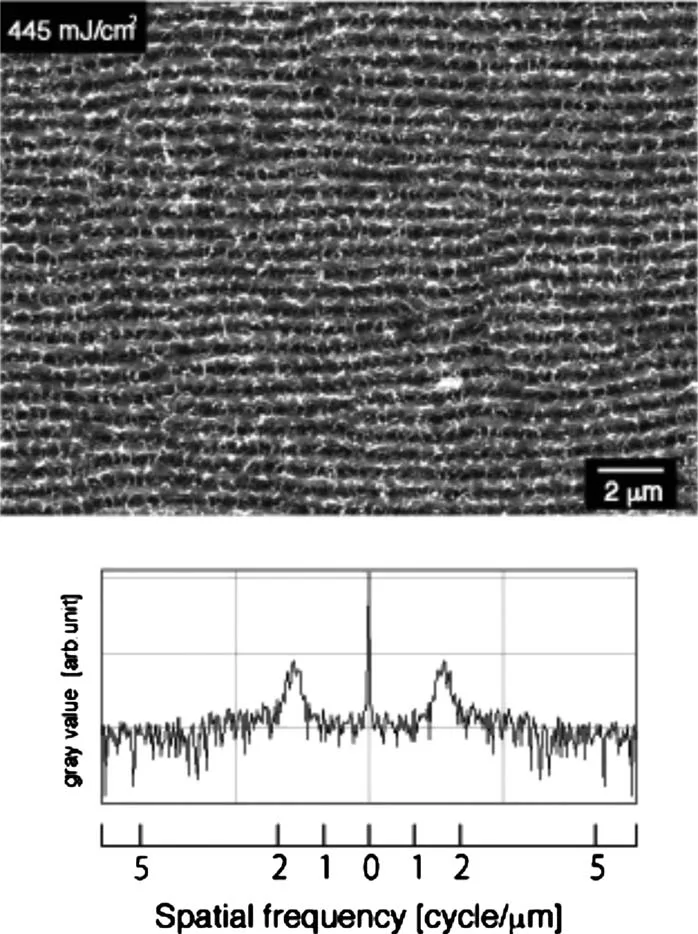
Figure: SEM images and Fourier-transform spectra of periodic structures on a tungsten surface produced by 50 pulses of 160 fs laser at 445 mJ/cm² under laser influence. [1]
In addition, LIPSS is applied in the development of sensors, the design of catalyst surfaces, and the improvement of surface wettability and friction characteristics. For example, forming LIPSS on a metal surface can create superhydrophobic or superhydrophilic surfaces, which is of great significance in materials science and surface engineering.
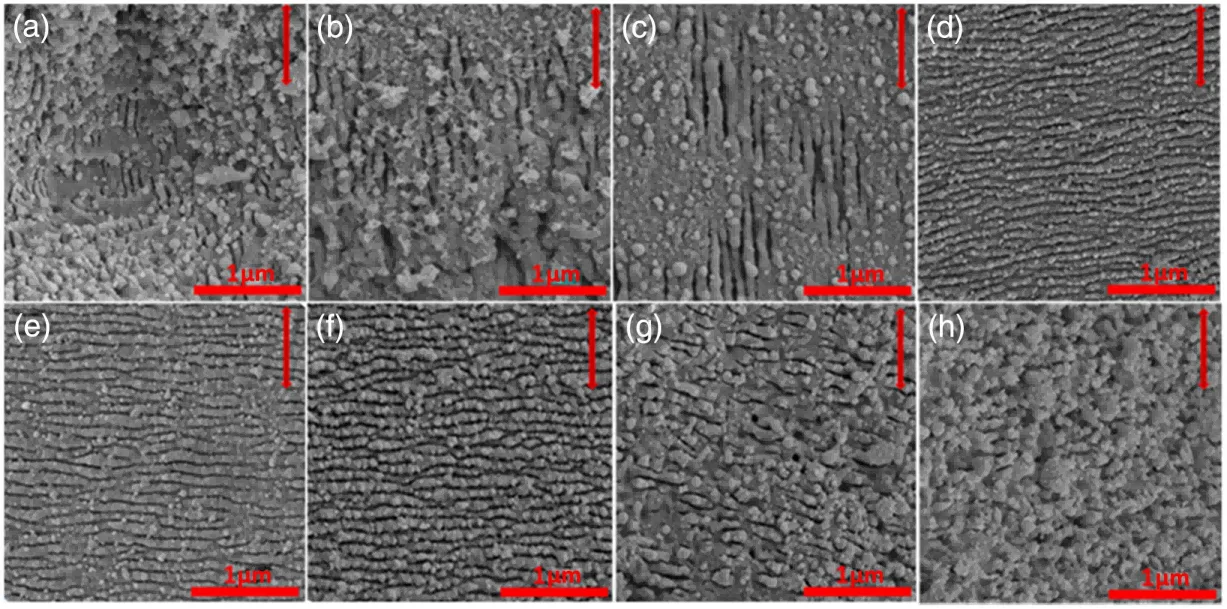
Figure: Periodic surface structures fabricated on a lithium niobate crystal by femtosecond laser irradiation, offering the possibility of producing nanogratings or nanostructures on wide-bandgap materials. SEM images of laser-treated LN surfaces under nitrogen at sample temperatures of (a) 28 °C, (b) 100 °C, (c) 200 °C, (d) 300 °C, (e) 400 °C, (f) 500 °C, (g) 600 °C, (h) 800 °C. Fluence, 7.0 kJ/m²; N₂ pressure, 500 Torr; scan speed, 2 mm/s. Red double arrows indicate the polarization direction of the incident laser. [3]
Femtosecond lasers play a key role in fabricating periodic surface structures. Because of their ultrashort pulse duration, femtosecond lasers can process materials with high precision without producing excessive thermal damage. This fine control makes it possible to form highly regular and uniform periodic structures on a wide range of material surfaces.
Femtosecond lasers also allow precise control of the features of the periodic structures — such as period, depth, and shape — by adjusting the pulse parameters. This flexibility makes femtosecond lasers an ideal tool for fabricating customized LIPSS, offering broad possibilities for materials design and surface engineering.